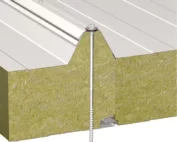
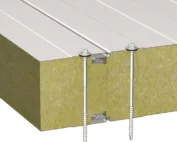
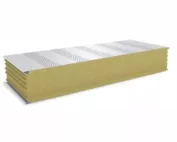
Mineral wool panels
Will a mineral wool panel soundproof the hall, and how do you read its acoustic parameters?
In brief
A mineral wool core does not mean that every panel absorbs noise well inside the room. A panel with full steel facings can limit sound transmission while reflecting it back into the room. First you need to establish the problem: noise outside, between rooms or reverberation in the hall. Each requires a different approach. Insulation describes limiting the passage of sound through a partition. Absorption concerns the energy that does not return to the room as a reflection. These are different properties. Material hidden behind full steel sheet does not behave the same as an exposed or suitably protected absorbent layer.
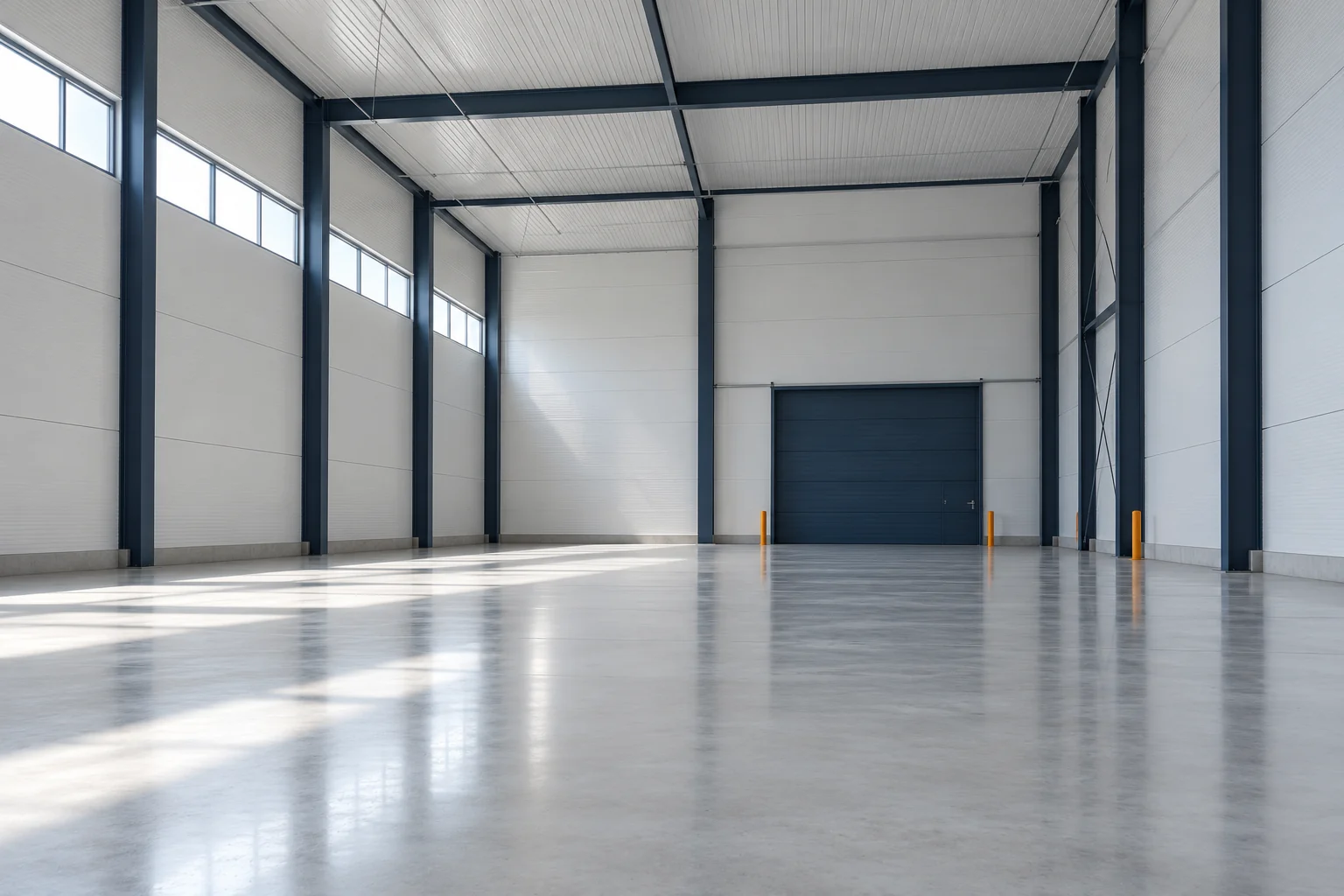
What do insulation and absorption mean?
If it is difficult to talk in the hall because of reverberation, increasing the insulation of the external wall may not solve the problem. If, however, noise is a nuisance outside the building, transmission through the walls, roof and openings must be assessed. The sound path is determined first.
How do you read Rw values and adaptation terms?
Rw is a weighted index of the acoustic insulation of a defined partition under test conditions. It is not a promise of the same level difference in every completed building. Additional indices help relate the result to the nature of the noise. A figure should not be chosen solely because it is the highest.
An example configuration of a wall panel with wool has Rw 32 dB, RA1 29 dB and RA2 28 dB. These values relate to a specific combination of facings and core. They must not be attributed to all panels with wool. The range of variants covered by the result must be checked.
Why is full steel sheet not an open absorber?
The steel surface closes the core on the room side. In the example full-wall configuration, the absorption coefficient αw is 0.20, with class E. This is a separate parameter from Rw. Good limitation of transmission does not automatically mean a high capacity to reduce reverberation.
Acoustic solutions intended for this purpose may be required. A standard facing must not be perforated independently to expose the wool. This changes the properties of the panel, the protection of the core and the fire conditions. The material should be designed for the given application.
How do the gate and gaps affect the whole façade?
A large opening can become a weaker path for sound transmission. Even a good wall does not compensate for an arbitrarily leaky gate. Doors, vents, windows and service penetrations must also be assessed. Their area, parameters and airtightness matter.
The insulation of a façade cannot be calculated by simply averaging decibel figures. The scale is logarithmic, and weaker elements can have a major influence. For a demanding building, proper calculations are needed. It is worth starting with a drawing of all openings before choosing a thicker panel.

Does a greater wool thickness always give a clearly better result?
There is no such universal relationship for a complete panel. The facings, the bond to the core, the geometry and the sound frequency all matter. The parameters must be read for the specific variant. Wool density alone is not enough to calculate the insulation of a finished partition.
Compare results determined by the same method and for the appropriate assembly. If two thicknesses are not covered by the same test or declaration, do not add a difference based on intuition. Installation conditions are equally important. An open joint can worsen the effect even of a good material.
How can transmission through building connections be limited?
Sound can reach the space by a path other than directly through the panel. Junctions with the ceiling, floor and adjacent walls are important. In the case of equipment, structural vibration is also present. Insulating the enclosure alone does not replace an assessment of the machine’s mounting and the connections of the installations.
The solution must be matched to the source and the intended use of the rooms. When planning an internal partition, also consider its termination under the roof. A wall that stops under a shared space can leave a flanking path. A section drawing helps to spot such places.
How should the requirement be described in a request for quotation?
State which noise is to be reduced and where the effect is assessed. Indicate the wall dimensions, openings and adjacent partitions. Ask for the appropriate panel parameter together with the range of its application. The term ‘acoustic panel’ alone is not precise enough.
Separate the cost of the enclosure from additional absorbing structures or vibration protection. Each element has a different task. Once the building is completed, the result depends on the complete solution. The requirement and the method of acceptance should therefore be established before purchase, especially in sensitive surroundings.
Questions before ordering
Does Rw 32 dB mean 32 dB less noise everywhere?
No. It is an indicator for a specific partition under test conditions. The effect in a building depends on openings, joints and other sound transmission paths.
Can the mineral wool be left exposed instead of a steel facing?
A standard panel should not be modified in this way. Sound absorption requires a product or assembly designed for that function.
7 branches. Materials closer to your project.