Sheet metal and roofing
What do 100 metres of sheet metal cost? Linear metres versus square metres
In brief
The question about 100 metres of steel sheet requires clarification of the unit. One hundred linear metres is the sum of the lengths of the sheets, while one hundred square metres is the area. The result also depends on the overall width or coverage width. These figures must be established before comparing prices. Otherwise, two similar amounts may refer to different quantities of material. A linear metre means a length of 1 m at a specified width. Twenty sheets of 5 m each give 100 linear metres. This does not yet indicate what area will be covered. The effective width of the specific profile is needed, along with information on any longitudinal joints.
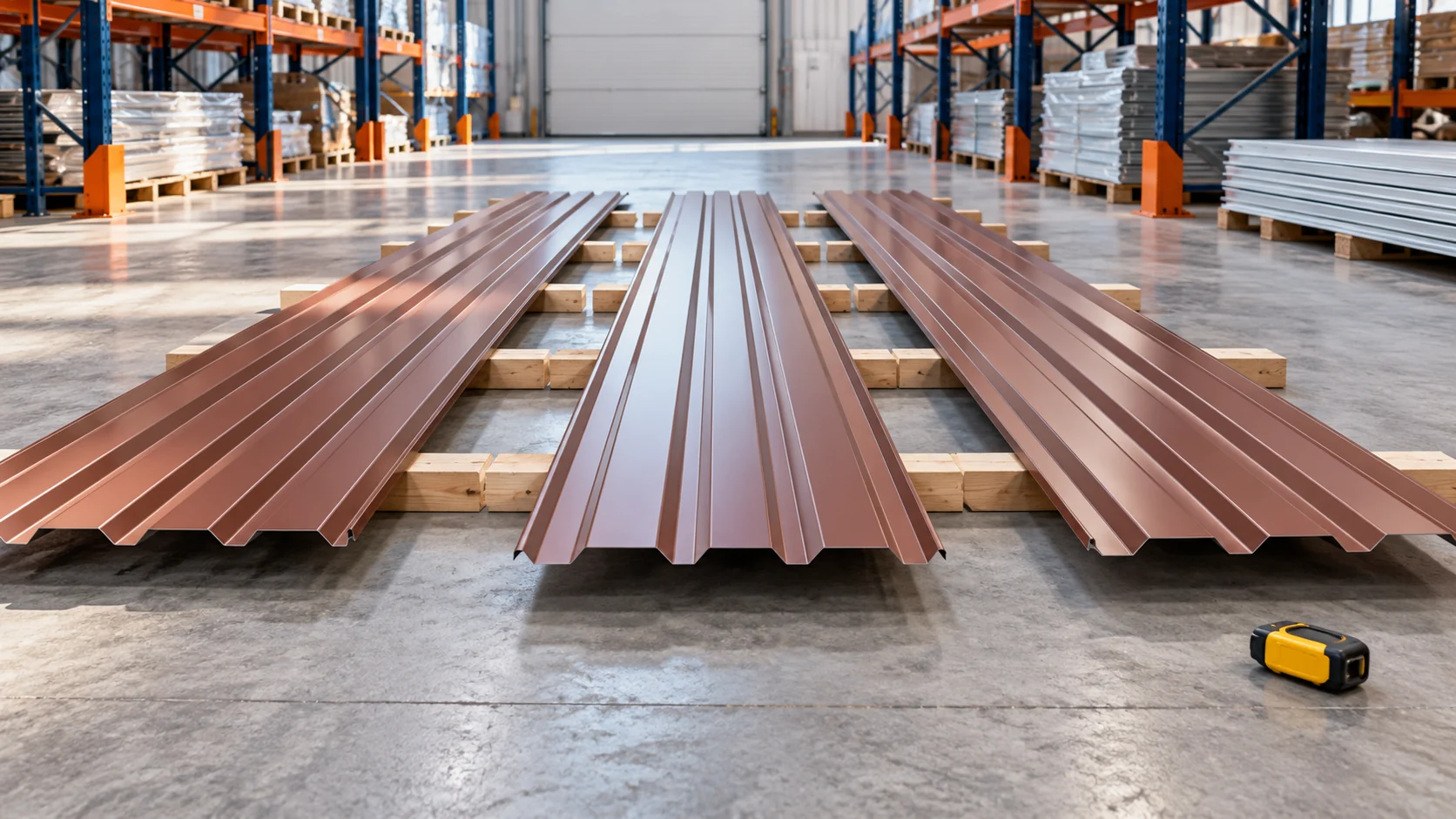
How to understand a linear metre of sheet?
Do not multiply running metres by the trapezoidal profile height. The profile height is a different cross-section dimension. What matters is the cover width after the side lap is formed. If the sheets have different lengths, first add them up separately in a clear itemised list.
What does the example of a profile with 1120 mm coverage show?
For an example variant with a cover width of 1.120 m, one hundred running metres gives 112 m² of effective area. If its overall width is 1.157 m, the total area of the same sheets is 115.7 m². Both figures relate to one delivery.
The values are an example of a specific geometry, not a rule for every T14 sheet. A different profile requires a different width in the calculation. In addition, cut-offs at the roof edge can reduce the used area. The effective area of the purchased strips does not always equal the area of the finished roof.
How to convert an example price per square metre?
Assume strictly for the calculation €11.57 net per m² total. For the described 100 linear metres the cost will be 115.7 × €11.57 = €1338.65 net. This corresponds to €13.39 net per linear metre. This is not a market rate, but an example of unit conversion.
If the agreed €11.57 related to the effective metre, the result would be 112 × €11.57 = €1295.84 net. The difference €42.81 here results only from the basis of settlement. Therefore a price without a note on the type of metre does not allow two offers to be compared fairly.
And if you need exactly 100 m² of coverage?
When covering 1,120 m, simply dividing 100/1,120 gives approximately 89.29 linear metres. This is only a preliminary area conversion. It does not account for full strips, roof slope shape or end treatments. The purchase must be broken down into actual sheets.
For example, a roof slope 20 m wide and 5 m long requires eighteen strips with a cover width of 1,120 m, because seventeen would give only 19.04 m of width. With 5 m sheets this would be 90 linear metres and 100.8 m² of effective area before cutting. Support and end positioning require separate verification.
How does a transverse lap change the total length?
If the roof slope is divided along the pitch, part of the length participates in the overlap. The sum of ordered sections must then account for this joint. Its dimension and sealing depend on the specific solution and the pitch. No arbitrary value should be assumed as universal.
Two 3 m sections do not automatically give 6 m of finished covering when joined. Similarly, with flashings the sum of nominal lengths may be greater than the covered edge. In the schedule it is worth separating the order dimension from the dimension achieved after installation.

Which other costs are not included in a metre of steel sheet?
Covering requires fastenings, flashings and specified seals. Transport and installation are separate. Their quantity does not result solely from one hundred linear metres. A short, wide roof may have a different edge layout than a long, narrow strip of the same area.
For a small delivery, the cost of the trip and the minimum order quantity matter. Long sheets require appropriate unloading and space. Material collected with one’s own transport should not be compared with a complete delivery to site without accounting for the difference in scope.
How should you word your enquiry to avoid misunderstanding?
Provide the profile, thickness, coating, colour and a list of lengths and quantities. Ask for the cover width and the total width to be specified. The quote should clearly state which unit the price refers to. Also distinguish between net and gross amounts.
Before approving, compare the sum of lengths with the cutting plan. Check whether the contractor has accounted for the eaves and joints. Such a record reduces the risk of buying the correct number of “metres” from which the planned roof slope cannot be closed. The unit is the beginning of the calculation, not its end.
If the enquiry covers several profiles, do not add their linear metres into one price item. Each may have a different cover width and coating. First price the groups separately. A combined figure of 100 linear metres will not show what part of the material goes on the roof and what part goes on side cladding or another surface.
Questions before ordering
Does 100 linear metres of sheet with a coverage width of 1.12 m mean 100 m²?
No. It gives 112 m² of effective area before allowing for cuts and any transverse overlaps.
Can a price per linear metre be compared directly with a price per m²?
No. It first has to be converted using the correct width, and it must be established whether this refers to the total or effective area.
7 branches. Materials closer to your project.