PIR insulation
IKO enertherm ALU TG in renovation: joints and perimeter cuts
At a glance
The damaged section of ALU TG lies in the middle of the existing field. Inserting a new element may require joining it to edges that lack a complete tongue-and-groove profile. The repair method must be determined for this specific geometry. Do not assume that the cut-out rectangle will retain factory contact conditions on all sides. In a renovation, the area described as insulation joined with a factory tongue and groove requires identifying the old layers. The first difficult place to inspect is the edge of the cut piece where the factory tongue has not been preserved. The thickness of IKO enertherm ALU TG should not be determined solely on the basis of an old drawing. The measurement should cover the width of the last strip and the position of the joint ends, taking into account changes made during earlier work.
What must be exposed before selection
On this basis, a row plan is produced marking the edges that remain after cutting. The purpose of the survey is to answer the question of whether the existing conditions allow full boards and cut pieces to be joined without gaps in the layer.
The right product and the scope of its data
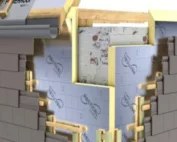
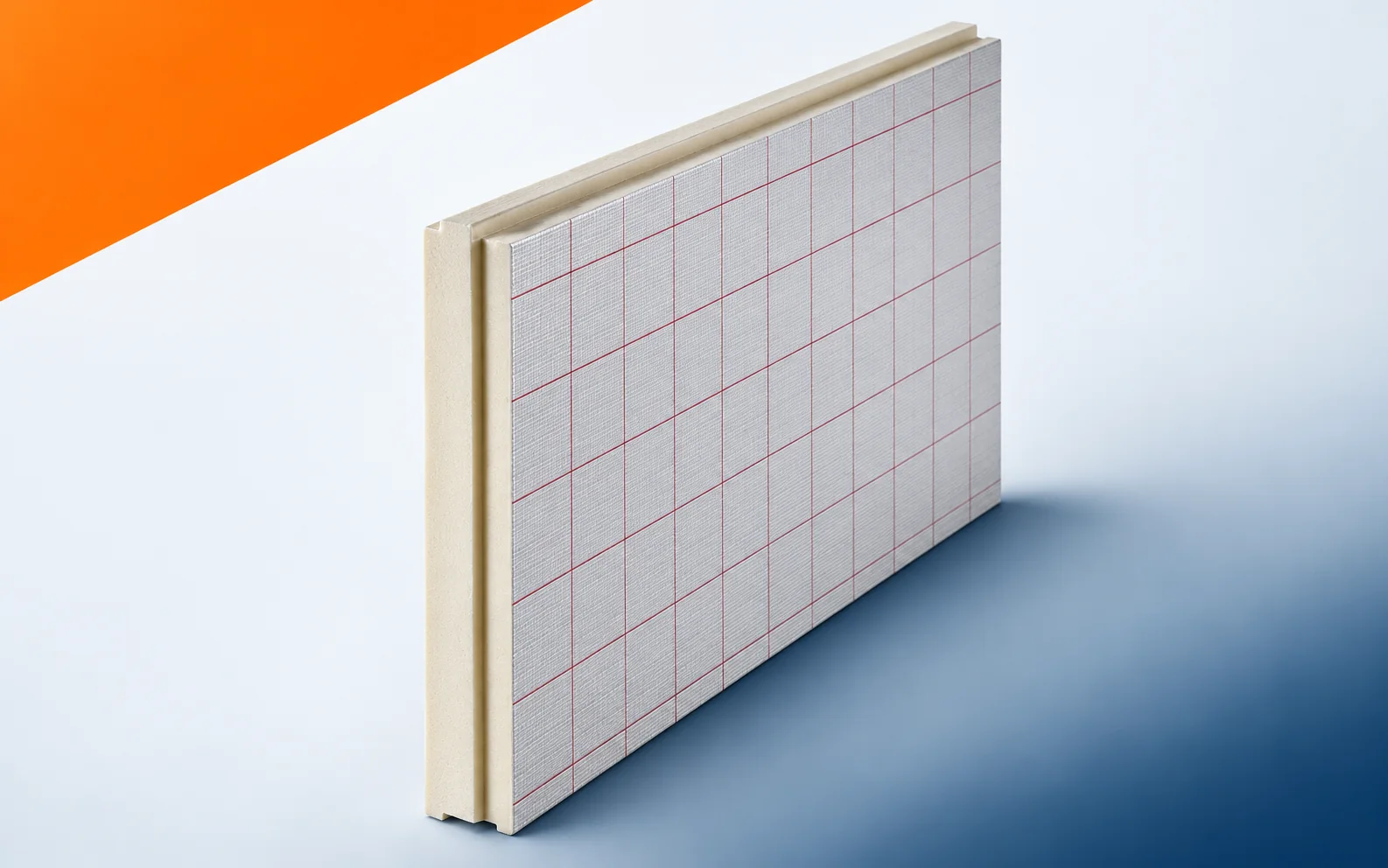
In IKO enertherm ALU TG, the factory tongue-and-groove profile helps to align the boards, but when the perimeter is cut, part of this shape is removed. Do not treat the tongue and groove as a structural connection or as independent protection against water. It is a product with a PIR core and aluminium laminate, for which a lambda of 0.022 W/(m·K) and a minimum compressive strength of 175 kPa are stated. The reaction of the board itself is class F; B-s2,d0 applies to a specific end use. On acceptance, check the ALU TG designation together with the edges and surfaces. The general name polyurethane insulation does not confirm that a complete element with the geometry envisaged in the cutting plan has been supplied.
Example versus the actual state of the renovation
For the last strip of IKO enertherm ALU TG, note the width of the cut piece and the position where the factory tongue and groove ends. The cut edge requires its own solution, irrespective of the board thickness. A separate, illustrative space calculation might look as follows: 150 mm available, 50 mm for other required layers, 100 mm for insulation. Using 120 mm would give 170 mm in total and would require changing the levels. This is not a recommended floor or roof cross-section. In a real renovation, therefore, check both the height and the joint without the profile after cutting; a thicker variant does not remedy this detail.
The calculation presented for IKO enertherm ALU TG serves to structure the decision-making initially. In an old building, the result must be confronted with the limitation: the absence of the factory profile on the edges after cutting. The property of the new board described as a tongue-and-groove profile in the ALU TG variant does not remedy the loss at another location. On site, the places where the factory profile is lost must be marked on the drawing before the final scope of work is adopted. The check should be documented by a row plan marking the edges that remain after cutting. If it proves inconsistent with the assumption, the order for IKO enertherm ALU TG must be adjusted before repetitive cutting begins.
Which scope of repair is justified
One measure under consideration is changing the width of the first row to achieve a more favourable final cut. The second may be to retain the full first row and resolve the perimeter separately, depending on the result of the exploratory opening. With IKO enertherm ALU TG, both variants should take into account the repair location: the cut edge without a preserved factory tongue. Before deciding, the assumption that every cut piece is an element with a complete factory joint must be eliminated. The result of the inspection should be assessed by the coordinator for cutting and laying ALU TG, who will link the repair with the other layers. Once agreed, a cutting plan is needed with the laying direction and termination details, including information on the elements retained after the repair.
The junction between new and old material
At the repair location, the tongue-and-groove profile with intact and matched edges must be identified and its termination at the existing section planned. The top of the new board is an aluminium laminate of the ALU TG variant; its interaction with the retained materials must be checked. For IKO enertherm ALU TG, matching the core name is not sufficient confirmation of adhesion or tightness of the joint. The basis for documenting acceptance is a description of the tongue-to-groove fit and the sealing of the perimeter. The next stage will be the finish laid after acceptance of the joints, so the scope of the correction should be closed earlier. In the repair documentation, it is worth distinguishing the cut edge without a preserved factory tongue and the boundary between the old and new work.
Phasing the work in an occupied building
The installation of IKO enertherm ALU TG must be linked to the possibility of protecting the exposed section. At every stage, a level substrate is required without forcing the joint into position by force, also appropriate after removal of the old layers. The location defined as the cut edge without a preserved factory tongue may require temporary protection during a work break. The plan should take into account the finish laid after acceptance of the joints, so that the next team’s schedule corresponds to the state of completion. The coordinator for cutting and laying ALU TG should be responsible for clarifying conflicts. Polyurethane insulation will then be part of the planned repair, the aim of which is to make the joints of full boards and cut pieces without gaps in the layer.
Acceptance after reinstating the layers
At acceptance, the scope comprising the thermal insulation joined with factory tongue and groove must be compared with the scope of the agreed repair. The reference document is the row plan with the edges remaining after cutting marked, supplemented by actual dimensions. It is worth keeping a description of the tongue-to-groove fit and the sealing of the perimeter, because once the layers are closed again the details will become invisible. The ordered PIR boards should have an identity consistent with the installed IKO enertherm ALU TG variant. If the problem returns, a record of how the cut edge without a preserved factory tongue was made will be useful. The review should not be limited to assessing the appearance of the new surface. It must be confirmed that the joints of full boards and cut pieces were made without gaps in the layer, and that the cause of the earlier defect was genuinely identified.
7 branches. Materials closer to your project.