Polystyrene and thermal insulation
How to interpret WL(T) water absorption in EPS documentation
At a glance
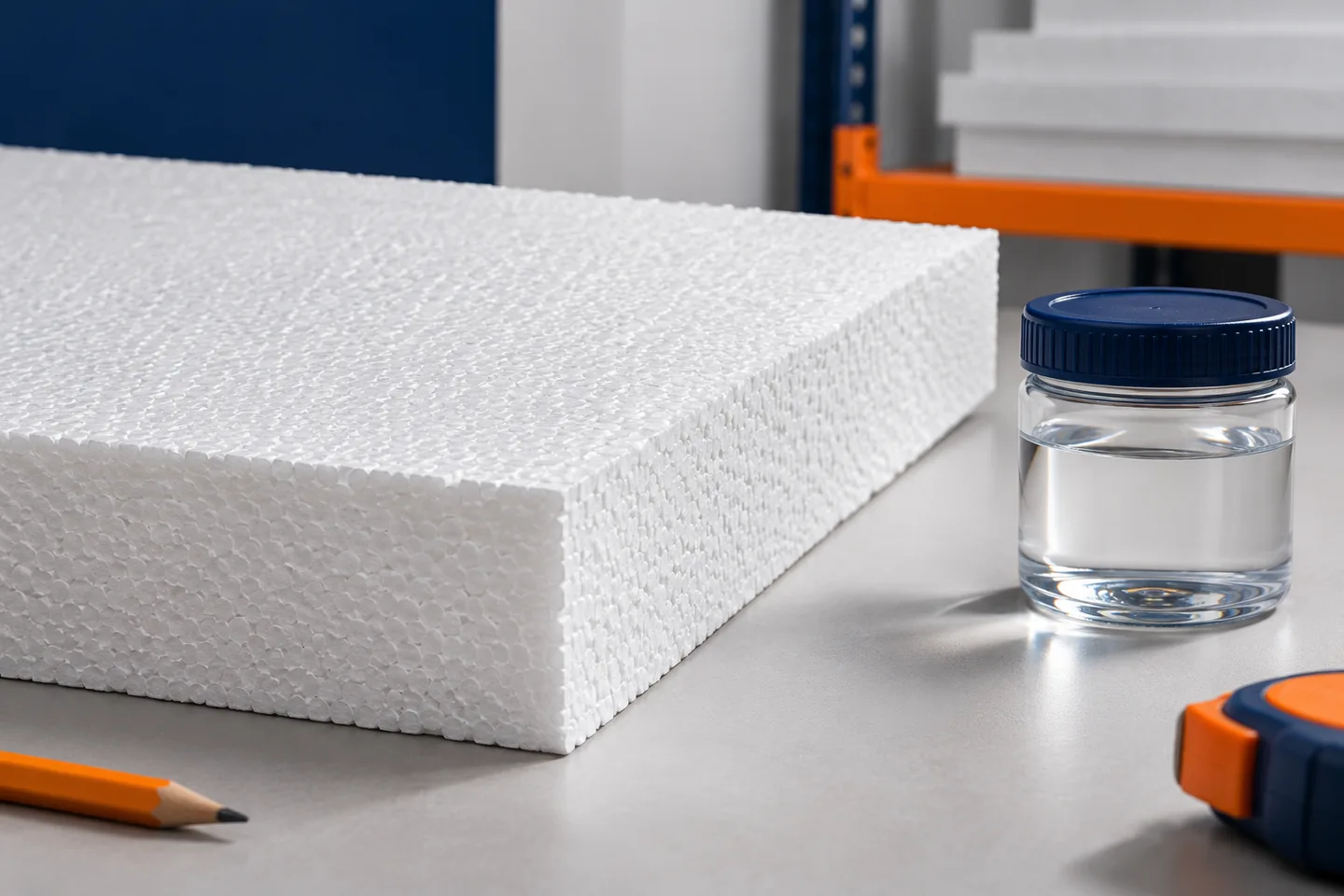
WL(T) specifies long-term water absorption by total immersion under the test conditions. The parameter matters when selecting EPS for foundations and other wetter locations. It does not, however, mean the building element is waterproof. We explain how to read the percentage values and what cannot be inferred from the code alone. The designation indicates the declared level of long-term water absorption by total immersion. For WL(T)3.5 the limit value is 3.5% by volume of water relative to the volume of the specimen. It is not a percentage of the dry board’s mass. The conditions and duration are defined by the test method. EPS documentation refers to long-term immersion lasting 28 days. A lower WL(T) level means less permitted water absorption in the same type of test.
What does the designation WL(T)3.5 mean?
This is why products with appropriately described declarations can be compared on this basis. However, results from different methods must not be mixed. A value given in kg/m² for partial immersion describes different conditions from a percentage by volume after total immersion.
Why does a foundation need this information?
Insulation in contact with the ground may be exposed to moisture and water to an extent that depends on the construction of the building element. Moisture affects the thermal performance of the material. Therefore, choosing the lowest declared lambda alone does not complete the assessment. Water absorption, mechanical properties and the description of the board’s application in the technical documentation are also important.
It is necessary to identify the water level, the type of soil and the way precipitation is drained. Periodic wetting differs from permanent immersion or hydrostatic pressure. Being approved for one situation does not automatically mean suitability in the other. The manufacturer may restrict the range of application of the product. These conditions must be checked regardless of a favourable WL(T) value.
Does WL(T) describe the moisture content of the finished wall?
No. It is the result of a specific test of the material. The actual water content depends on exposure, the layer build-up and the possibility of drying out. It cannot be assumed that the board in every foundation will achieve exactly the value from the designation. Nor can it be assumed that a lower level guarantees a complete absence of moisture throughout the entire service life.
Similarly, WL(T)3.5 does not mean that the lambda value will always deteriorate by 3.5%. The relationship between moisture and heat conduction requires an appropriate method and data. In design, thermal values corresponding to the operating conditions are used. Simply adding the percentage of water absorption to the lambda value is an error. Two different parameters do not become interchangeable just because both influence the choice of board.
Why does EPS not replace waterproofing?
The boards and their joints do not automatically form a watertight barrier against water. Even a material with limited water absorption does not seal service penetrations, cracks in the masonry or the junction between the wall and the footing. Protection of the building is provided by a properly designed damp-proofing or waterproofing layer. EPS is primarily intended to perform the function of thermal insulation.
The waterproofing must be continuous and suitably protected. When fixing the boards, it must not be accidentally pierced. The adhesive should be compatible with both layers. Backfilling the excavation must not cause damage to the coating and the thermal insulation. A good WL(T) declaration does not compensate for sharp stones, a leaking penetration or water constantly directed from the gutter at the foundation.
What other parameters should be checked together with WL(T)?
Read the lambda value, the thickness and the CS(10) level, as well as the required data on long-term behaviour. Earth pressure and other loads depend on the specific situation. CS(10) alone is not a permissible service load. In some applications, the results of other tests relating to water, temperature and dimensional changes are also relevant.
The label may also feature designations relating to water absorption by diffusion. These should not be equated with WL(T). Every symbol requires correct interpretation. If the design specifies a particular property and the data sheet does not state it, clarify the omission before purchase. A similar colour, a grooved surface or a rebated edge do not replace the required declaration.
How should materials for the foundation be compared?
Compare products approved for similar operating conditions. Compare the complete set of properties, thickness and recommended installation method. Check whether the documentation limits the depth or contact with water. If the material is changed, the designer should assess whether the required parameters are maintained. A difference in a single number does not determine whether the entire solution is correct.
EPS boards with limited water absorption are offered by, among others, Yetico, Termo Organika, Styropmin and Knauf Therm. The WL(T) value must be read for the specific grade.
Keep the product data sheet and the waterproofing documentation. For a later assessment of moisture, information on both layers will be needed. A correct comparison begins with identifying the conditions at the building. Only then can it be decided what water-related and mechanical requirements the foundation thermal insulation should meet.
7 branches. Materials closer to your project.