Polystyrene and thermal insulation
How can you compare EPS with XPS without confusing their properties?
At a glance
EPS and XPS are both made from polystyrene, but they differ in their production technology and in the properties of specific products. You cannot choose between them solely on the basis of colour, how hard they feel in the hand or a colloquial name. We explain how to compare lambda, water-related and mechanical parameters, and when the board’s range of application matters. EPS is made from expanded polystyrene granules bonded together into a material. In boards, the characteristic granular structure is usually visible. XPS is produced by extrusion and direct expansion. It has a different, fine-cell structure. Both groups are used for thermal insulation, but their names are not interchangeable. Parameters must be read from the documentation for the specific product.
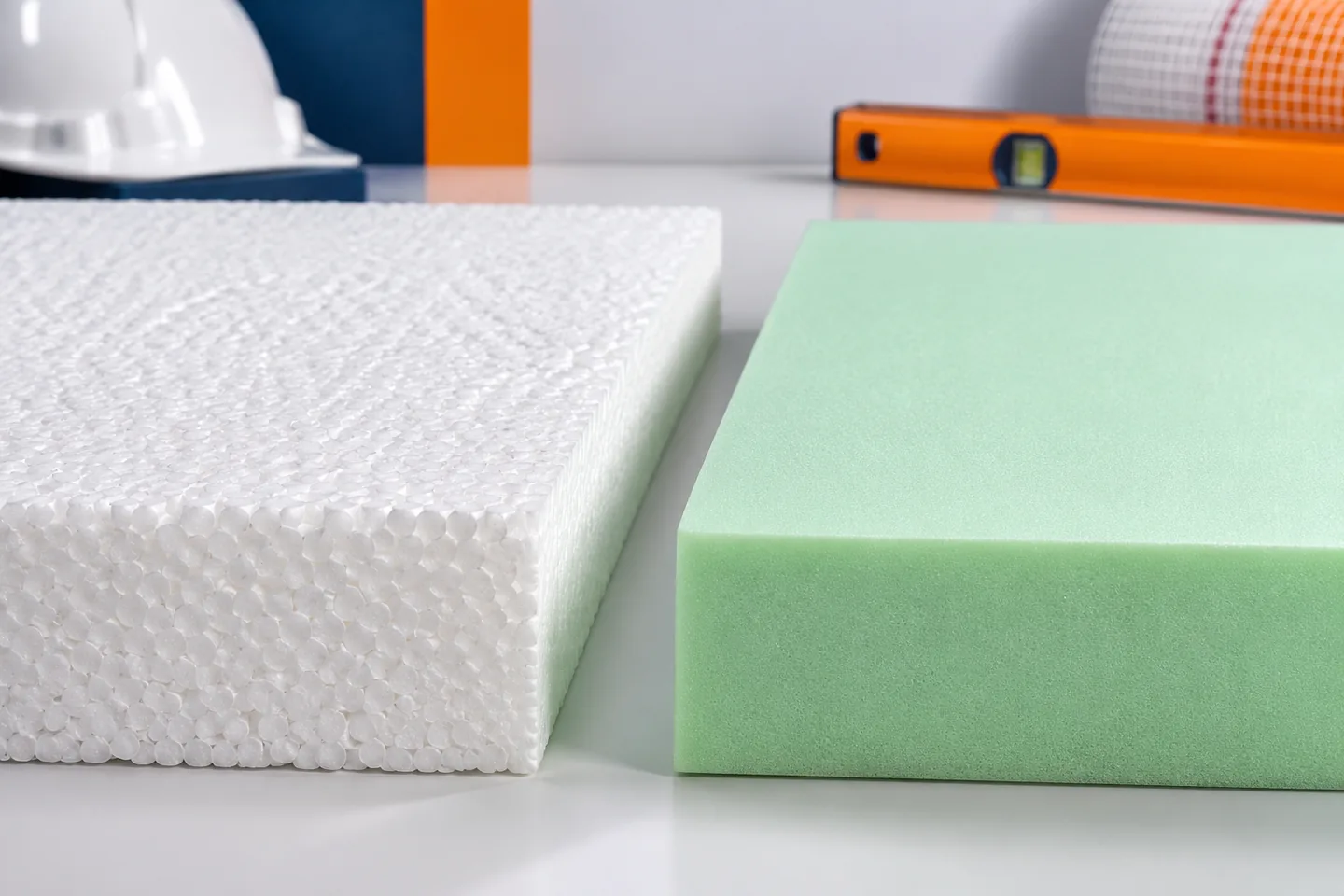
How does the structure of EPS and XPS differ?
For EPS boards, the documentation specifies EN 13163, and for XPS EN 13164. This is a helpful distinction when checking a delivery. Colour is not enough. EPS boards can be white, graphite or coloured, and XPS also comes in various colours. A blue or green board is not automatically an extruded material. The shape of the edge profile also does not determine the type of polystyrene.
Does XPS always have a better lambda value?
Such a rule should not be assumed. Both groups contain different declared values, and graphite EPS may have a lower lambda than the XPS board being compared. In addition, for some XPS products λD depends on thickness. The comparison should relate to the actual variant to be used. A single number describing an entire product family can be misleading.
The thermal effect is also determined by thickness. The resistance of a layer results from R = d/λ. Where space is limited, it is worth comparing the material needed to achieve the same resistance. However, this is not a complete comparison of application. A board with a more favourable lambda must simultaneously meet the water, mechanical and system requirements in the given part of the building.
How should water resistance be compared?
XPS is often chosen for zones with increased exposure to moisture. However, there are also EPS variants with limited water absorption and specific foundation applications. Instead of assessing the entire group in one sentence, compare the declared test results and the scope of application. The conditions of contact with water are important, not the marketing term ‘waterproof’ alone.
Total immersion, partial immersion and water absorption by diffusion describe different methods. Do not compare their results directly. Also check the limitations regarding depth and type of water exposure. Neither EPS nor XPS replaces a complete waterproofing of the building component as a matter of principle. Board joints and service penetrations still require appropriate solutions.
What does the comparison of mechanical parameters say?
The XPS range includes products with high compressive stress levels. EPS also has variants designed for different loads. Compare CS(10) and the long-term deformation data needed in the design. A higher figure at CS(10) is not a ready permissible service load. In both materials, the distinction between testing and the performance of the building element applies.
The screed, the support and the way forces are transferred all matter. The weight of equipment on small supports may require a separate detail. Buying a harder board does not always fix an incorrect layer build-up. Likewise, higher density does not settle all characteristics. The right choice follows from the load and the requirements, not from comparing a thumbprint on two samples.
Can the materials be interchanged in every system?
No. In ETICS, the board must remain compatible with the system documentation. The surface, mechanical parameters and adhesion to the relevant layers all matter. Replacing EPS with XPS board across the entire façade is not simply a change of material colour. Likewise, a roof build-up requires compatibility with the covering, the fastening and the moisture conditions.
The inverted roof is a common application for XPS, but there are also specific EPS boards approved by the manufacturer for such a build-up. One must neither exclude the entire EPS group nor extend this application to every variant. Check the specific documentation. Reaction to fire can also differ between products, so do not assume one class for all XPS or EPS boards.
How do you make the decision for a specific project?
First describe the conditions: installation location, moisture, loads, required thermal performance and available space. Then compare products that meet this set of requirements. Include the installation method, edges and the costs of the entire solution. The price of one cubic metre does not yet show the cost of achieving the same function in a finished building.
EPS expanded polystyrene is produced by, among others, Austrotherm, Swisspor, Yetico and Termo Organika. The range should be compared at the level of the properties of specific boards.
When substituting the material, check the design and the documentation of the adjacent layers. Do not assume that a product with one higher parameter is automatically equivalent. A good comparison ends with identifying the material suitable for the given location. This makes it possible to use the properties of both groups without attributing to them advantages and limitations that apply only to a single variant.
7 branches. Materials closer to your project.