XPS insulation
XPS on a balcony. Where does it help, and where does it not eliminate the thermal bridge?
At a glance
A balcony often connects an external slab to a heated building. In such a place, the heat flow depends on the construction of the connection, and not only on the layer laid on top. XPS can be part of a balcony’s thermal insulation and help to limit losses. Extruded polystyrene is light, has low water absorption and can be cut precisely. These advantages are useful in tight details. However, they do not mean that any insulation board will eliminate every structural thermal bridge. A reinforced concrete slab passing through the wall can conduct heat to the outside. XPS laid only on its upper surface changes the conditions but leaves other paths for heat flow. The detail is therefore analysed together with the wall, the underside of the balcony and the edges.
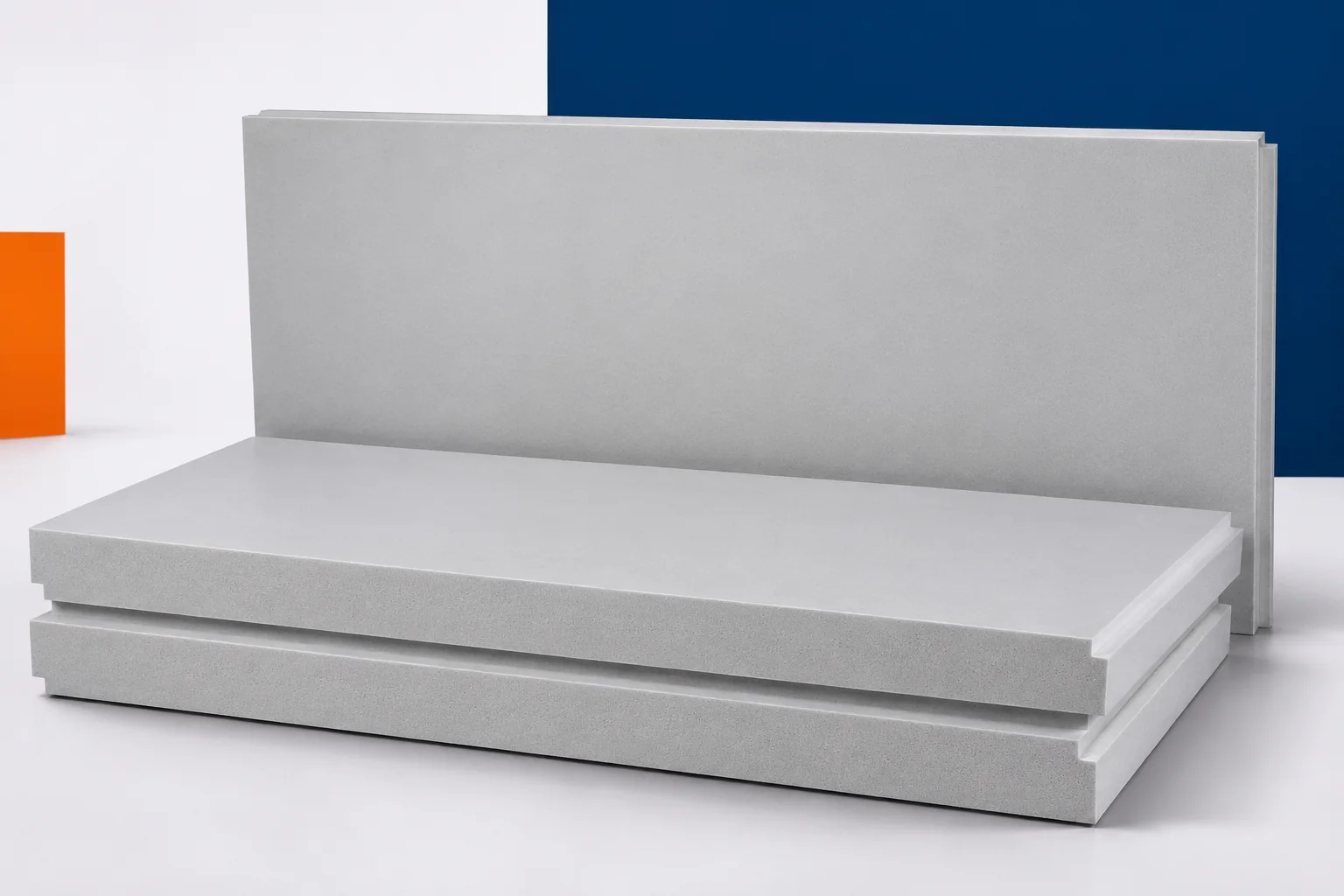
You have to look at the whole cross-section
The required scope of insulation is determined by the design. The mere view of an insulated surface from above does not allow the entire junction to be assessed.
Extruded polystyrene can be useful in refurbishments when easy working helps to adapt the material to the existing geometry. However, it does not replace a designed structural solution that limits conduction. XPS and the load-bearing element have different tasks. With a new balcony, it is worth settling this question early, because later thermal insulation does not always offer the same possibilities as a correctly designed connection.
The height at the door sets the limits
On a balcony, the thermal layers, waterproofing and finish must all fit. At the door threshold, the available height is often limited. XPS should be selected after comparing the entire cross-section and the required levels. A low lambda value can increase thermal resistance at a given thickness, but it does not provide unlimited freedom. Correct sealing of the threshold should not be sacrificed in order to fit in an additional layer.
Extruded polystyrene can be ordered in various thicknesses, which makes it easier to adapt to the design. The thermal parameters must be checked for the board actually selected. XPS should not be thinned on site in a way that creates a random, uneven layer. If space is lacking, an assessment of the entire detail is needed. Sometimes the solution requires changing the level of the finish or a different layer arrangement.
Low water absorption is an advantage outdoors
A balcony is exposed to precipitation and temperature changes. XPS with properties suitable for such an application limits water absorption into the insulation. This is important because the thermal layer should maintain predictable performance under real conditions. In the documents, water absorption and freeze-thaw-related characteristics should be checked if they are needed for the adopted system.
Extruded polystyrene remains thermal insulation, and watertightness is provided by the layers intended for that purpose. XPS does not seal the balustrade penetration or the junction at the doors. Water must have a drainage path, and the surfaces must have the correct falls. A good combination of these functions allows you to benefit from the material’s advantages without expecting that low water absorption will fix a leak elsewhere on the balcony.
The wearing layer distributes loads
People move around on a balcony and furniture stands on it, sometimes heavy planters too. XPS is selected for the system that transfers these loads. What matters are the layers above the insulation and the way the surface is supported. A board with a high compressive parameter is not on its own a basis for placing an arbitrarily heavy object on it. Long-term deformation and the load-bearing capacity of the balcony must also be taken into account.
An even substrate and well-fitted edges make it easier for the layer to perform correctly. Extruded polystyrene can be prepared for recesses and the outline of the slab without heavy labour. However, XPS should remain supported in accordance with the design. Voids, bumps and loose sections are not a good way to level a surface. Careful installation helps maintain the intended levels and an even transfer of loads.
Edges and fixings are part of the thermal insulation
The junction between the XPS and the façade should maintain the continuity envisaged in the detail. Edge trims must simultaneously drain water and protect the layers. It is worth planning them before bonding the boards, so as to leave the right space for fixing. This prevents the thermal insulation from ending in an accidental step that later has to be concealed with a thick layer of mortar or a poorly fitting trim.
The balustrade transfers forces to the structure, so its anchoring requires a separate solution. XPS is not a load-bearing substrate for such fixing. The watertightness of penetrations through the balcony layers must also be maintained. Agreeing these points in advance helps limit later drilling in the finished assembly. This benefits both the durability of the finish and the control of waterproofing connections.
A sensible scope of work for renovation
XPS is offered by Synthos, HOCH and Finnfoam, among others. The choice of material should match the intended use and the planned balcony assembly. The word styrodur does not specify its thickness, strength or method of bonding. Before purchase, it is worth agreeing the complete layer build-up and the way the edges are finished with the contractor. This makes it possible to assess the quantity of material needed and the realistic scope of work.
Extruded polystyrene can improve the thermal performance of a correctly detailed balcony. XPS is particularly convenient where low water absorption, light weight and precise fit matter. However, the result should stem from an assessment of the whole structure. An honest answer to the question of the thermal bridge also covers what remains outside the board layer itself. This gives the renovation a clearly defined goal and a predictable scope of benefits.
7 branches. Materials closer to your project.