Polystyrene and thermal insulation
What does the EPS code on an insulation board label mean?
At a glance
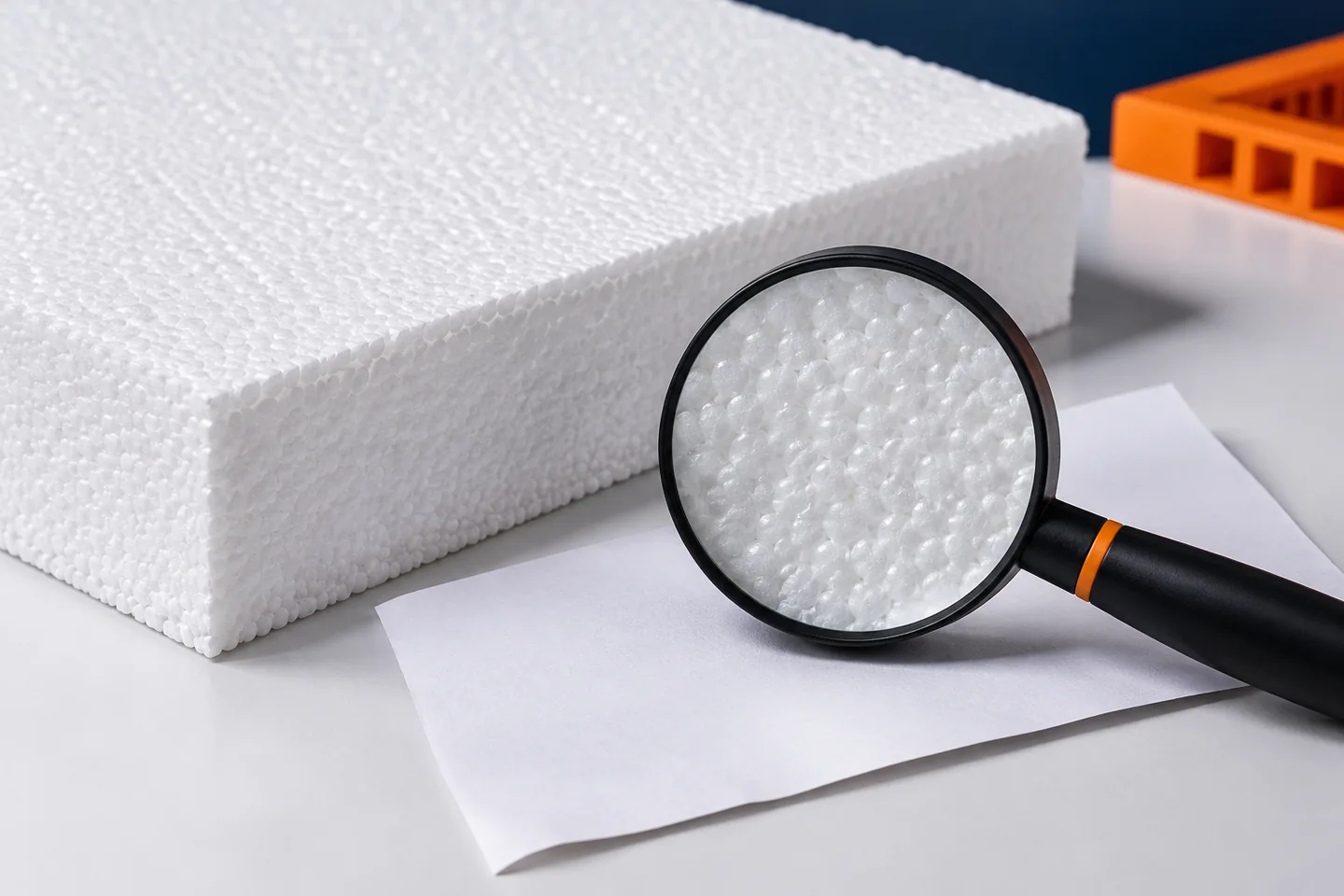
The EPS code on the packaging describes the properties of the board in a structured way. It contains information on dimensions, stability and selected mechanical characteristics. However, it does not replace the entire documentation or the insulation design. We explain the most important symbols and show how to distinguish a declared parameter from a general trade name. EPS stands for expanded polystyrene, i.e. the material commonly known as polystyrene. It is made from expanded granules bonded into a board structure. The designation does not in itself determine whether the product is suitable for a façade, a foundation or a floor. Different grades of EPS have different properties. Further data and the declared application are needed for selection. The documentation for boards for the thermal insulation of buildings refers to standard EN 13163.
What do the letters EPS and the standard number mean?
A reference to it indicates a common way of describing properties. It does not mean that all boards covered by it have identical parameters. Two products conforming to the same standard can differ considerably in thermal conductivity, compressive strength, water absorption and dimensional behaviour.
How should the geometry designations be read?
The T symbol relates to thickness tolerance, L to length and W to width. The Sb designation refers to squareness, while P refers to flatness. The number next to the symbol indicates the declared class or level. The exact meaning must be read from the properties table. Not every number in the code is simply a dimension in millimetres, and not every one is subject to the same interpretation.
For example, the thickness class states the permissible deviation from the nominal dimension. It does not tell you how thick a board you are buying. A thickness of 150 mm must be read from a separate item on the label. In practice, geometry affects how the joints fit and how even the layer is. A good thermal parameter does not eliminate the problem of boards damaged during transport or stored incorrectly.
How do CS(10), TR and BS differ?
CS(10) describes the level of compressive stress at ten per cent deformation. It is important in loaded applications, but it does not constitute a permissible service load. TR means tensile strength perpendicular to the board surface. It matters, among other things, when selecting EPS for façade systems. BS relates to flexural strength.
These parameters cannot be used interchangeably. A high CS(10) value does not automatically confirm compliance with the TR requirements in a specific ETICS. Conversely, a board with a suitable TR does not have to be suitable for a heavy floor. The numbers next to these designations are usually given as levels in kilopascals. Always check the full table and the way the requirements are stated for the given product.
What do DS, DLT and WL(T) say?
DS describes dimensional stability under specified test conditions. Various variants relating to temperature and humidity may be found in the code. DLT concerns deformation under a specified load and temperature. These data should not be equated with any behaviour of the board on site. Each result has an assigned method and verification conditions.
WL(T) denotes long-term water absorption by total immersion. It is important when comparing materials for damper zones. A lower declared level means lower permitted water absorption in this test. It does not mean watertightness of joints or replacement of the wall’s waterproofing. The conditions of use for foundation applications must be checked separately in the documentation.
Where can I find lambda and the reaction to fire?
The declared thermal conductivity is designated as λD. It is usually given outside the long property code. The lower the lambda, the greater the thermal resistance of a layer of the same thickness. The label may also show RD, i.e. the declared resistance for a specific board dimension. Do not confuse these values with the Uc of the entire building component.
The reaction-to-fire class describes the product under the conditions covered by the classification. Class E appears in many EPS board documents. The classification of the entire thermal insulation system may be different and relates to a defined set of layers. Do not transfer it to the exposed board or to any combination of adhesive, mesh and render. The product code does not replace the ETICS system documents.
How can I compare two labels without making a mistake?
Start with the function of the material in the building. Then compare the required parameters, thickness, format and range of application. Check the declaration number and the delivery identification. Names such as “facade” or “floor” help with orientation, but do not constitute a complete specification. If there are discrepancies between the label and the data sheet, clarify them before installing the boards.
Well-known EPS manufacturers include Austrotherm, Swisspor, Termo Organika and Styropmin. Their documentation should be compared for specific material grades.
Keep a photograph of the legible label and the declaration of performance. This will make it easier to confirm what was actually installed. There is no need to memorise the entire code. What matters more is recognising the symbols required for the given application and being aware that a single good result does not replace the assessment of the other properties.
7 branches. Materials closer to your project.