Installation and workmanship
What are sheet metal flashings and where does a roof need them?
In brief
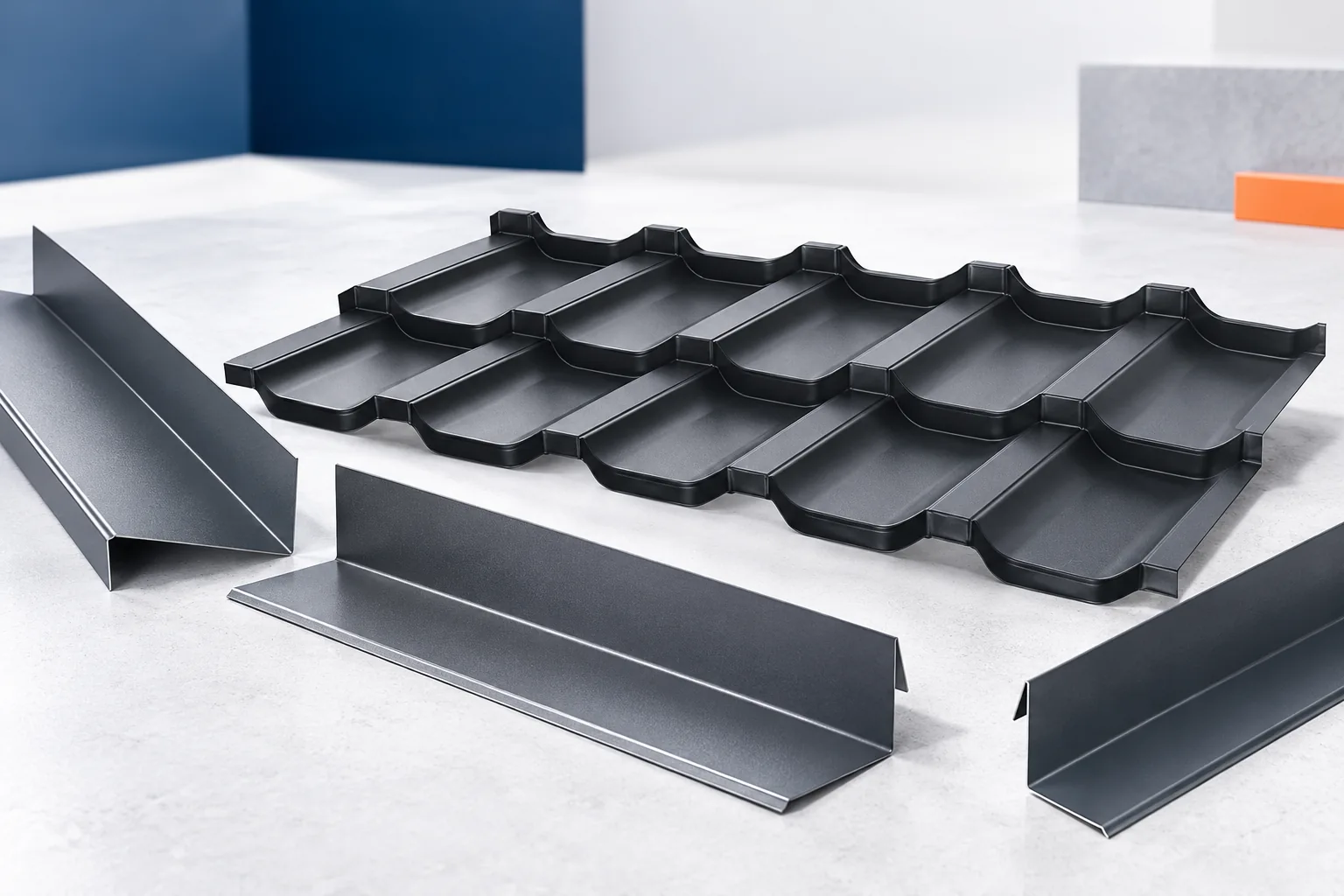
Flashings are there to carry water through places where an ordinary roofing sheet does not provide continuity — at the edge of a slope or against an obstacle such as a chimney. When planning, the first thing to check is whether the profile of the flashing directs the flow onto the next drainage surface, rather than merely covering the edge. Equally important is whether the detail works together with the layer beneath the covering and does not close off the required airflow. The shape depends on the specific location, so the colour of the sheet alone is not enough.
What does a flashing actually do?
The primary task is to conduct water through the point where the ordinary covering sheet does not provide continuity. This may be the edge of a roof slope or an obstacle such as a chimney. The profile of the flashing must direct the flow onto the next drainage surface. An accidental gap facing upstream becomes a weak point even with solid fixing.
The flashing often also protects the ends of the sheets and wooden elements. It must not, however, close off the required airflow. Particularly at the eaves and ridge, protection against precipitation must be reconciled with ventilation. A thick layer of sealant does not solve the problem of a poorly chosen shape. Nor does it replace a correct overlap between parts.
What elements occur at the eaves?
At the eaves, the covering, membrane, substructure and gutter meet. Water flowing over the sheet and moisture drained from beneath the covering may have separate paths. Eaves strips must correspond to this arrangement. Their height and projection are determined together with the position of the first row of covering, not only after all sheets have been screwed down.
Before installation, check whether the stream will reach the gutter and whether air has access to the ventilation gap. A gutter positioned too low or too high can cause overflow. With a strong flow from a roof valley, the detail must be assessed separately. There is no single universal strip shape that will correctly handle every roof and every drainage system.
How do the ridge and the side edge differ?
The ridge protects the upper end of the adjoining roof slopes. In a ventilated roof it usually participates in discharging air from beneath the covering. The seals and tapes used beneath it should protect against wind-driven precipitation without blocking the intended flow. The shape and fixing of the ridge tile must correspond to the sheet profile.
The barge flashing protects the side edge of the roof slope. Its task includes covering the edge, but also cooperation with the fixings in the zone of strong wind action. It should not be regarded as a purely decorative element. A wide, flexible strip without proper support may vibrate. The flashing dimension is determined according to the height of the substructure and the type of covering.

Why does a roof valley require a separate plan?
The roof valley collects water from two roof slopes. Leaves, dust and snow may flow towards it. A clear drainage zone and adequate support for the flashing are needed. The edges of cut sheets must not accidentally close the channel. The width and method of sealing depend on the roof geometry and the recommendations for the covering system.
Avoid making connections or fixings in a way that creates holes in the main flow path. The fixing method should be determined before cutting the covering. The roof valley should be accessible for inspection and cleaning. Especially under trees, account must be taken of sediment accumulation that ordinary rainfall runoff will not remove.
How is the junction with a chimney or wall resolved?
At a vertical obstruction, the flashing must direct water onto the covering and limit its penetration behind the top edge. The roof and chimney may behave differently. The detail should therefore accommodate movement rather than relying on rigid sealing of all parts. The method of closing the top junction depends on the wall material and the chosen system.
The layer beneath the covering is also important. Water that reaches the membrane above the chimney requires a safe path around it. A sealed external flashing does not repair a interrupted membrane. With a wide obstruction, the design may require a solution that divides the flow. This detail should not be determined only after the first leak.
What should be provided when ordering flashings?
A cross-section drawing with dimensions is needed, along with the lengths of sections and indication of the coated side. Specify the colour, material, method of connection and required terminations. The description ‘chimney flashing’ alone does not define a finished component. It is also advisable to agree who is responsible for measurement and fitting on site. This helps limit accidental reworking of the finished coating.
At acceptance, check the direction of laps, fixings, seals and the free flow of drainage. Swarf and cutting remnants must be removed. Transport film must not remain permanently. Flashings should form a logical water path from the top of the roof to the drainage. If this path breaks anywhere, the detail should be corrected before completion of the works.
7 branches. Materials closer to your project.