Polystyrene and thermal insulation
Declared and design thermal conductivity: what is the difference?
At a glance
Declared lambda allows products to be compared under defined reference conditions. For a building component calculation, a value appropriate to its operating conditions is needed. The two figures may coincide, but not always. We explain where the difference comes from, when moisture matters and why no arbitrary margin should be added to lambda. The λD coefficient describes a material’s ability to conduct heat under defined reference conditions. It has the unit W/(m·K). For layers of equal thickness, a lower value means greater thermal resistance. The declaration is based on the rules specific to the given product. It is not an arbitrary number chosen to match the name on the packaging, nor the result of a measurement of an entire wall.
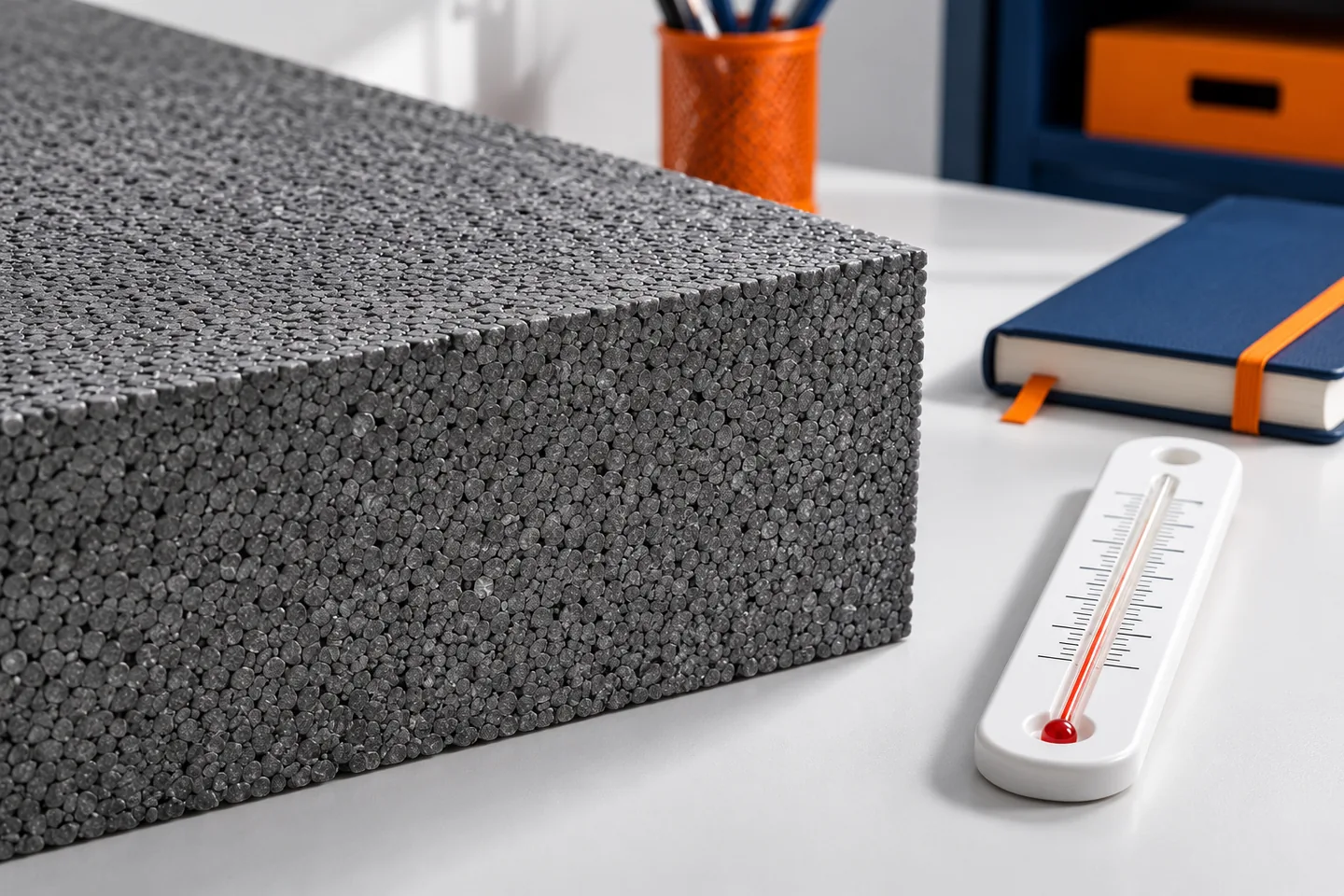
What does the manufacturer declare on the label?
The declared value enables materials to be compared on a common basis. When comparing two boards, use their current declarations and the same units. Pay attention to the exact product designation and the thickness if the document differentiates the parameters between variants. The number used in the name may aid orientation, but it does not replace the table of properties.
Why might the design assume a different value?
The conditions in which the material is used may differ from the reference conditions. The value used for calculation should correspond to the anticipated temperature and moisture in the building component. Specific rules for converting thermal values serve this purpose. It is not a matter of arbitrarily worsening the manufacturer’s data. It is a matter of matching the description of the material to the situation in which it will perform.
If the reference conditions can be regarded as appropriate for a given application, the declared value may also be suitable for calculation. There is therefore no universal rule that the design lambda must always increase by a fixed percentage. Justified assumptions and an appropriate method are needed. A random multiplier applied to every EPS does not give a reliable result.
When does moisture become particularly significant?
Material placed at the foundation may perform under different conditions than a board protected in the dry part of the wall. The ground, water and layer arrangement must be identified. Moisture can impair thermal insulation performance. Therefore, when selecting EPS for such locations, water absorption and the declared range of application also count, not only the lowest λD figure.
The WL(T) value comes from a specific water absorption test. It does not directly describe the moisture content that will always occur in the finished foundation. One should not simply add the WL(T) percentage to the lambda. A design assessment requires the correct relationship and assumptions about the service conditions. Waterproofing, tight joints and protection of the boards against damage must be ensured separately.
How does the difference in lambda affect the thermal resistance of the layer?
The thermal resistance of a homogeneous layer is calculated as R = d/λ. The thickness d is given in metres. For 20 cm and λ = 0.031 W/(m·K), the result is approximately 6.45 m²·K/W. If λ = 0.034 W/(m·K) were adopted in an example analysis, the thermal resistance of the same thickness would be approximately 5.88 m²·K/W. This shows the influence of the input data on the result.
The figures given serve only to illustrate the calculation. They do not mean that every board with a declared lambda of 0.031 must be designed as 0.034. The appropriate value is determined for the material and the application. The R result also relates only to the EPS layer itself. Calculating the U or Uc of the entire building component requires taking into account the other elements and the relevant corrections.
How can offers be compared fairly?
First compare λD with λD, and then assess the required application. Comparing the declared lambda of one material with the calculated value of another can create an apparent advantage. Every figure should be accompanied by a description of the conditions and its source. For foundations, check the water-related data at the same time, and for floors, check the mechanical properties and behaviour under load.
Do not treat a lower lambda as proof of better quality in every respect. Thinner insulation can help at reveals or with limited floor height, but it does not solve all requirements. Conformity with the system, correct geometry and proper execution are needed. A good thermal value will not compensate for gaps between boards or inadequate waterproofing.
What should be asked when verifying a design?
Check which lambda value has been adopted and why. It should be assigned to a specific material or a clearly defined specification. Also ask about the moisture conditions and how they are taken into account in the calculations. This is particularly useful when you replace a product after the design has already been prepared. The same thickness of the new board does not guarantee identical performance of the building component.
EPS boards are produced by, among others, Termo Organika, Yetico, Styropmin and Austrotherm. For each grade, the correct declared λD value must be read off.
Keep consistency between the design, the order and the delivery documentation. When the assumptions change, recalculate the required effect instead of copying the old thickness. In practice, most mistakes result from mixing different data without describing them. A clearly stated lambda, its basis and the place of application allow the solution to be assessed without guesswork.
7 branches. Materials closer to your project.