Metal pickets and fences
Sheet thickness for fence pickets. How to read the figures without oversimplifying?
In brief
Sheet thickness is an important parameter of a picket, but on its own it does not describe the quality of the fence. In offers for actual products, values such as 0.45 mm, 0.50 mm and a range of 0.5–0.6 mm appear, among others. This does not mean there is a single standard common to all models. Before comparing, it is necessary to establish what the number refers to and what conditions accompany it. Metal pickets are assessed together with the cross-section, length, material grade and method of fixing. The term ‘sheet thickness’ is sometimes used as shorthand. It is worth confirming whether the documentation refers to a specific thickness of the steel substrate or to a differently defined dimension of the product. Tolerances are also important. A more precise meaning should not be added to a number from a commercial description on one’s own. The basis should be the data of the specific picket and the material from which it is made.
Ask what thickness is declared
Metallic and organic coatings have their own parameters. The paint thickness given in micrometres is not the thickness of the steel core. Likewise, the mass of the metallic coating expressed in grams per square metre describes a different characteristic. Listing these values in one column without explanation makes comparison difficult. Each of them should retain its own unit and scope of meaning.
Do not compare different cross-sections with a single number
Thicker sheet with the same material and geometry changes the behaviour of the element. In practice, the sheet-metal pickets being compared often have different profiles. One is narrower and more deeply embossed, the other wider and shallower. They also differ in edges and the position of fixings. A ranking based only on thickness ignores these features.
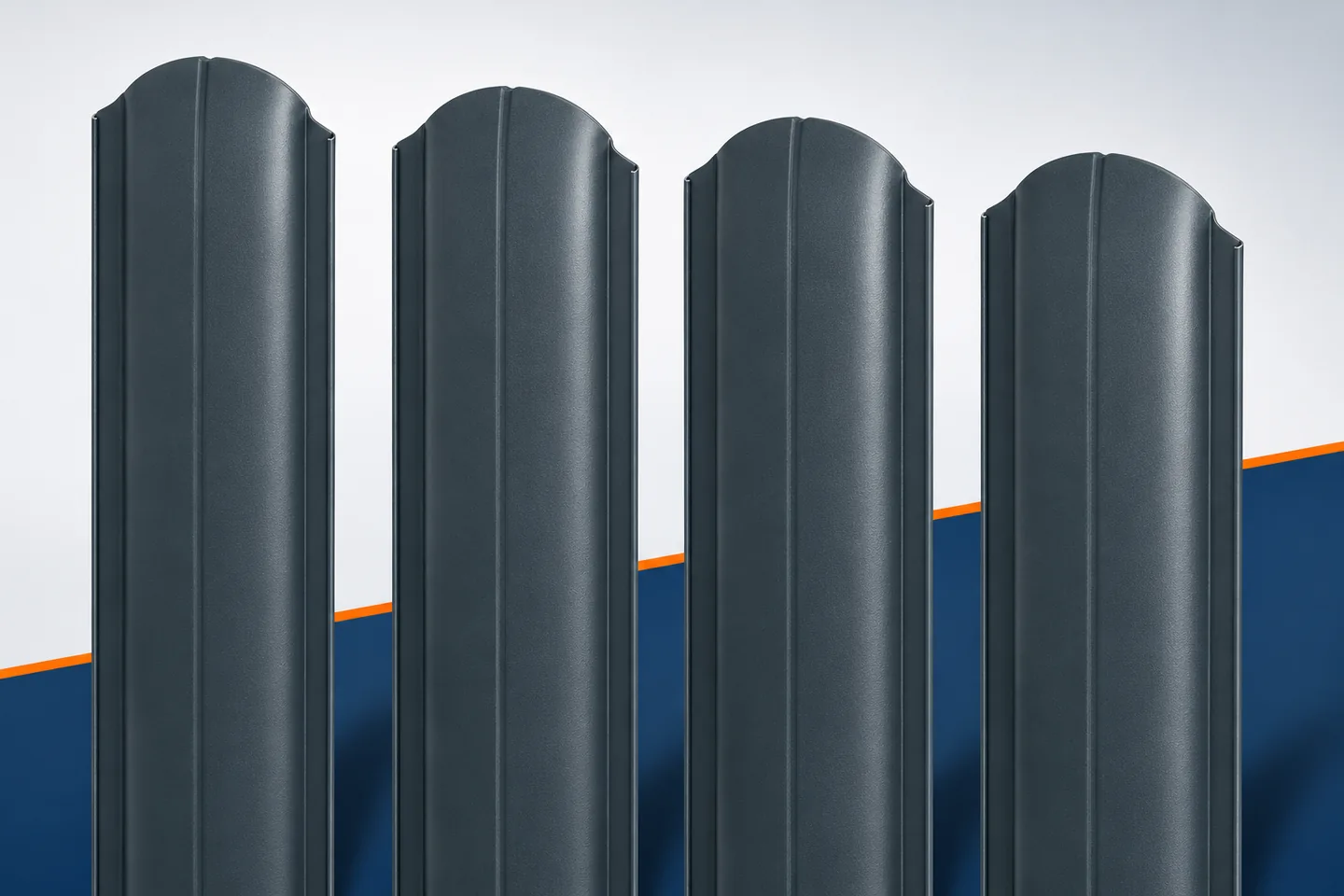
Before assessing, ask for a cross-section drawing. Look at the width of the finished picket, the profile height and the recommended lengths. Check whether you are comparing products intended for the same arrangement. One may be designed for vertical installation, another also for horizontal. Thickness does not replace the instructions on support and maximum application dimensions.
Measuring a finished element requires caution
A simple measurement with a calliper may not give a reliable answer with such thin material. The accuracy of the instrument, the point of application and the condition of the surface matter. A folded edge may consist of two layers of sheet. Placing the jaws at such a point will show a different dimension than measuring a single wall. Hasty conclusions should not be drawn on this basis.
A result that includes the coatings is also not automatically a measurement of the steel itself. Assessing conformity requires a defined method and proper documentation. If there is a specific doubt, it is worth passing it on to the supplier with a description of the measurement. A good question concerns the tolerances and the method of verification. Pressing the profile with your fingers is not a method of measuring thickness nor proof of quality.

Do not confuse thickness with coating resistance
Sheet-metal pickets may have a similar steel thickness but different surface protection. A matt or glossy appearance also does not determine the anti-corrosion protection. The type of metallic substrate, the coating system and its application must be known. The material should correspond to the actual environment, not only to expectations regarding rigidity.
Thick sheet with a damaged surface does not become indifferent to operating conditions. Conversely, a properly selected coating will not fix an incorrect support spacing. These are different parts of the same decision. When ordering, it is worth recording the structural parameters and the finish in separate items. This will facilitate later inspection of the delivery and avoid the vague term “better sheet”.
Account for length and fixing points
A long picket should not be assessed in the same way as a short sample. The distance between supports affects the deformation of the element. Therefore, even a clear change in thickness does not justify arbitrarily extending the span. Permitted dimensions and connections must be checked in the system. The production capability to make a long picket does not mean there is no need for additional support.
The same approach applies when changing from a single-row to a double-row layout. More elements mean a different mass and a different degree of infill. The structure should be selected as a whole. Metal pickets are part of the fence together with posts, rails and connectors. Searching for a single number that guarantees the durability of the entire system leads to oversimplifications.
Enter the parameter in the full specification
A good order specifies the cross-section, the declared thickness, the length, the coating and the finish of both sides. If tolerances and material identification are available, they should also be retained. This allows the received pickets to be compared with the agreed variant. The colour name and the number of pieces alone do not describe the product precisely enough.
The sheet thickness for pickets is worth taking seriously, but without making it the sole criterion. A reliable assessment combines documentation with geometry and installation conditions. Then it is clear what the declared value means and what it can be used for. This is a much better basis for selection than the belief that every picket with a higher number in the description will be the best in any fence.
7 branches. Materials closer to your project.