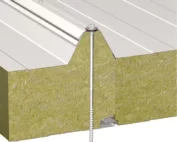
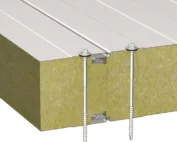
Mineral wool panels
How do you compare a lighter and a denser variant of an insulated wall panel with a mineral wool core?
In brief
Two lines of mineral wool panels can look almost identical yet differ in core and parameters. The lighter variant is not by definition inferior. The denser one need not be the warmest. It is worth comparing specific values for one thickness and the same wall build-up. The name of the line does not replace such a comparison. The basic difference is often the density and structure of the mineral core. The facings, the geometry of the joint and the range of applications may also vary. One should not assume that the difference is limited to price or the amount of wool.
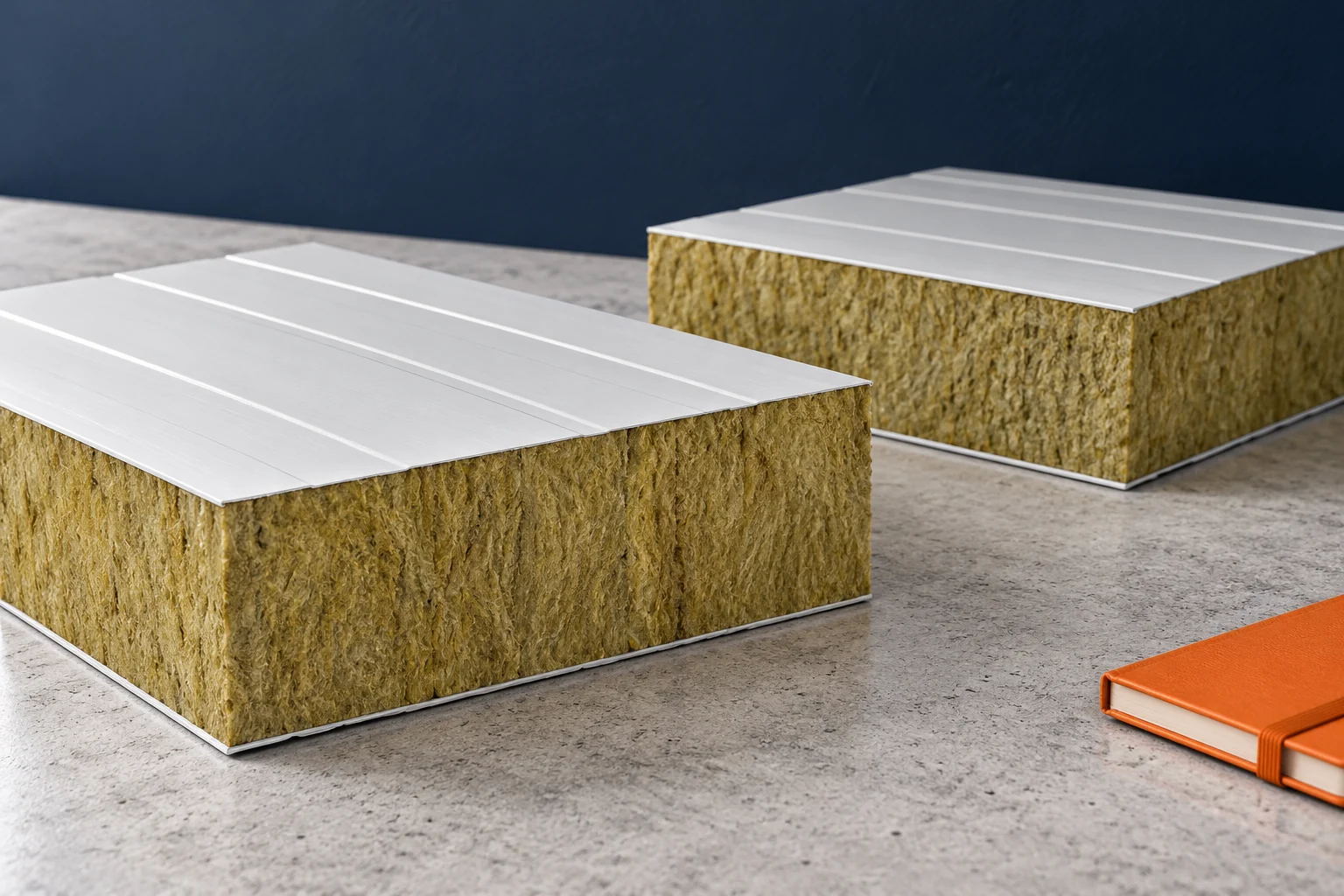
What can differ between two panel families?
In the example families, the core has a density of around 110 or 90 kg/m³. However, the finished panel also contains steel and other components. Therefore, the panel mass is not calculated from the wool volume alone. The comparison must keep the same thickness and facing configuration. Only then does the actual difference between products become visible, without mixing several variables at once.
What are example differences in weight and U-value?
For a thickness of 100 mm, masses of around 19.8 and 17.8 kg/m² can be compared. The corresponding Uc values in these examples are around 0.41 and 0.40 W/(m²·K). A lower mass therefore does not automatically mean a worse thermal result.
For a wall with an area of 80 m², a mass difference of 2 kg/m² gives 160 kg. This is important logistical information, but not a complete assessment of the structure. The U difference, in turn, requires reference to the whole building balance. Do not choose a variant just because one number looks more favourable. Load-bearing capacity, fire requirements and available lengths must also be checked.
Why must load-bearing capacity be checked separately?
The core works with the facings to transfer loads. A change in its properties can affect the panel’s behaviour. The permissible span cannot be derived from density or mass alone.
Compare the tables for the exact thickness, facings and support scheme. Pay attention to wind load, temperature and deflection limits. If the lighter variant requires a different purlin spacing, this must be included in the costs. Conversely, the absence of such a difference must follow from the data, not from a similar-looking cross-section. The panel is a composite product, so a single core characteristic does not describe its entire performance.
Do both variants have the same fire properties?
They may have the same reaction-to-fire class while differing in the wall’s fire resistance range. EI results may depend on thickness, orientation and span. A table should not be copied from one line to another.
Check the full identification in the documents. If the project specifies a particular configuration, the proposed replacement must be assessed against all requirements. Adding fixings or choosing a similar colour does not confirm equivalence. Connections to the structure and openings are also important. The requirement applies to the finished envelope, not to the core sample viewed on a table.

How can building geometry change the comparison result?
On a wall with regular full panels, both variants may give a similar layout. With many short sections, the available lengths, modules and production limitations are important. Pay attention to the zones at the gate and corners.
On a tight plot, the lighter panel may make lifting organisation easier, but it still requires suitable equipment and a gripping method. The weight difference must not be converted into any arbitrary reduction in the number of people. The length and rigidity of the element also determine the installation method. It is worth comparing the cost of delivery, unloading and laying together with the price of the panels themselves.
How do you prepare a fair comparison of two offers?
Enter thickness, core, facings, module, weight and Uc side by side. Add the required classifications, load-bearing range and coating conditions. Establish the same quantity and lengths of elements. The quote should cover the same scope of extras.
| Question | Why is it important? |
|---|---|
| Do both variants meet the project requirements? | It prevents comparing different functions |
| Do they need the same structure? | Reveals the cost of supports and fixings |
| Do they fit the cutting plan? | Shows the actual quantity of material |
Only then can the more advantageous variant be chosen. A name suggesting a basic or reinforced version is not a standalone technical criterion.
A sample allows the appearance and geometry to be assessed, but does not on its own confirm the density or load-bearing capacity of the core. Do not assess quality by pressing with a finger or by fibre colour. Data assigned to the actual batch is needed.
It is also worth checking whether both lines offer the required internal coatings. The difference in available surface protection may be more important than a small saving in weight.
Questions before ordering
Does higher wool density always improve thermal insulation?
No such simple rule can be assumed. The declared parameters of the specific core and of the entire panel are needed. Density alone does not replace the U-value.
Can the lighter variant be substituted for the denser one without checking?
No. Load-bearing capacity, fire performance, thermal properties and installation conditions must be compared. Equivalence must apply to the entire application.
7 branches. Materials closer to your project.