Insulation and PIR
PIR or XPS for a flat roof: how to decide based on the layer build-up?
In brief
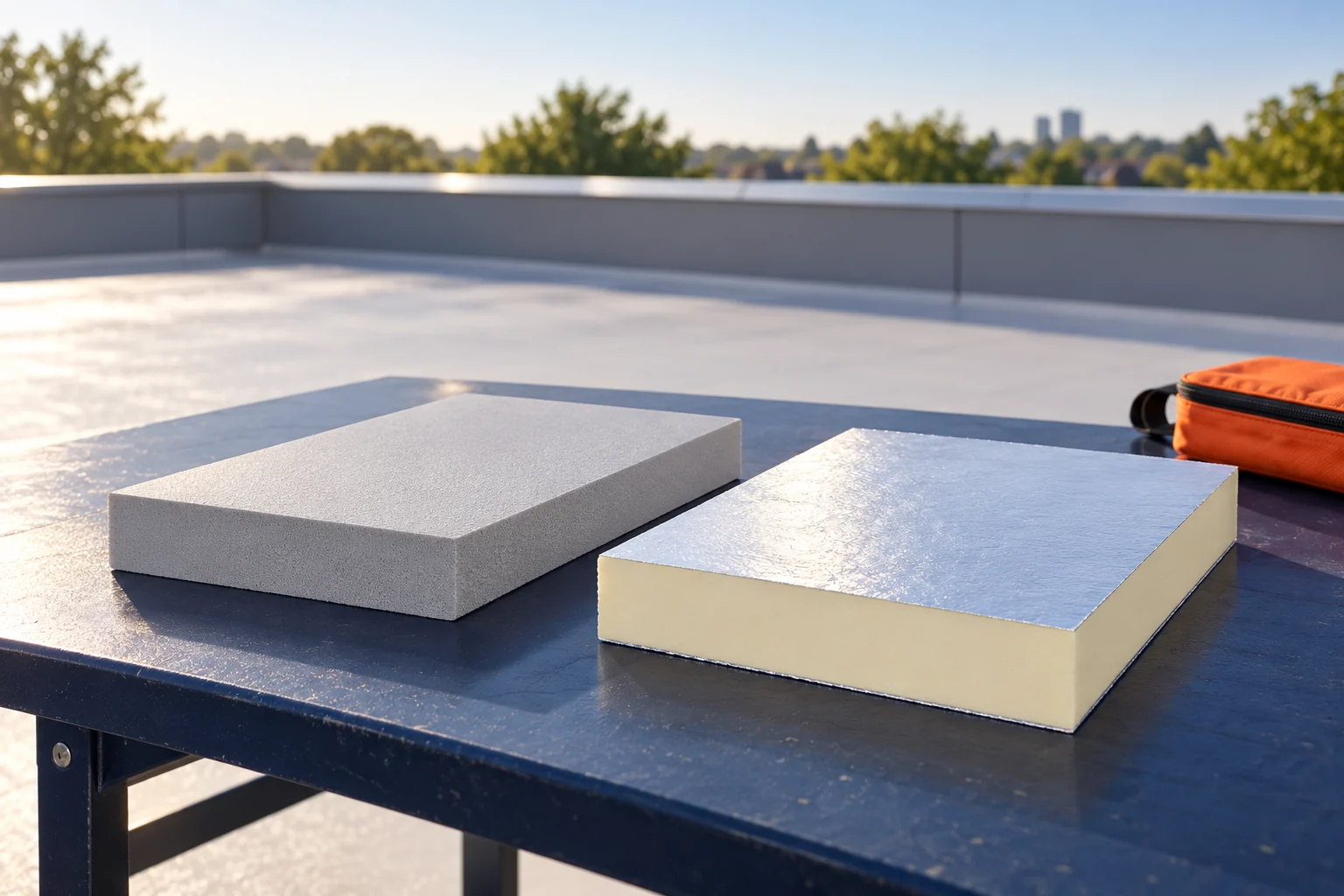
On a flat roof, the layer build-up is chosen first, and only then the insulation. PIR placed beneath the waterproof covering performs differently from XPS in an inverted roof. Moisture, load and the method of fixing all matter. A lower lambda alone does not confirm that the material is suitable as a substitute in an existing solution. In a classic roof, the insulation sits beneath the waterproof layer. In an inverted roof, the thermal insulation lies above the waterproofing. That is the fundamental difference in service conditions. A material in the upper position must be suitable for contact with water and for the intended method of draining precipitation.
Where is the waterproofing located?
Not every PIR board is approved for both systems. There are families whose instructions provide for the classic roof only. Suitable XPS variants, in turn, are used in inverted roofs. Always check the specific product and the complete solution.
How to compare insulation performance without shortcuts?
Compare the lambda of the relevant variant and the required resistance of the layer. For example, at an assumed R = 5 m²K/W, insulation with a lambda of 0.022 requires a calculated 110 mm. For an assumed lambda of 0.034, the result is 170 mm. This is an example for two parameters, not a common rule for entire groups.
Thickness matters at the parapet, the door threshold and the outlets. However, a thinner board cannot be chosen at the expense of compliance with the moisture conditions. The coefficient of the whole roof also depends on the other layers, fasteners and details. The R of the insulation alone is not the U of the finished assembly.
What to check for contact with water?
XPS has a closed-cell structure and, in suitable variants, low water absorption. This does not mean that drainage is unnecessary. Water must have a defined drainage path, and all layers should correspond to the chosen system. Thermal insulation does not replace a watertight waterproofing layer.
With PIR protected by a covering, the tightness of that covering and the correct arrangement on the interior side must be maintained. The suitability of the material is not assessed solely by briefly pouring water on a sample. The declared properties and the conditions of long-term service count.
How to understand compressive strength?
The stress value at 10% deformation describes the result of a specific test. It is not a ready-made allowable permanent pressure on the roof. The long-term behaviour and the way loads are distributed must be taken into account. This applies to both XPS and PIR.
Equipment supports, a terrace on pedestals and service traffic can create local pressures. They require appropriate load distribution. It is not enough to divide the total weight of the equipment by the roof area. The design should cover the actual support points and protective layers.

How do you match the facing to the covering?
PIR boards are available with different surfaces. The selected facing must match the membrane, adhesive or other method of installation. Not every bituminous membrane may be applied by any method directly to every board. The build-up must be checked as a whole.
When changing the material, the fixing and separating layers must be reassessed. Some products may be incompatible with the insulation. Protection during the works is equally important. Leaving tools on and dragging packs across the finished surface can damage components that will later be covered.
What difference does a low parapet make?
In a roof renovation, the available height is often limited. The slope, insulation, covering and the required upstand at the wall must all fit. Calculating only the thickness of a flat board can give a seemingly favourable result. At the thickest point, the slope layer takes up more.
Also measure the height of thresholds and the position of outlets. If the new build-up does not fit within the details, the upstand of the waterproofing should not simply be shortened. The solution needs to be corrected. The choice of material should follow from the full section from the structure to the parapet flashing.
In a renovation, also check the height at the doors leading onto the roof. Raising the level of the layers can change the threshold and drainage detail. This point should not be resolved only after the entire insulation has been laid.
How do you compare the cost of two solutions?
Compare complete roofs with a similar intended effect. Include the covering, fixing, ballast or usable layers, as well as the drainage details. The price of the insulation alone does not cover the differences between a conventional and an inverted roof. The load-bearing capacity of the existing structure is also important.
The quotation should clearly state the position of each layer. This way you avoid buying material selected for a different build-up. The final decision is based on compatibility, loads and the feasibility of sealed details. Only in such a comparison does the price per square metre have a useful meaning.
Questions before ordering
Is every PIR suitable above a waterproofing layer?
No. Some product families are intended solely beneath a waterproof covering. The permissible application must be checked for the selected product.
Does XPS remove the need to form a roof fall?
No. The low water absorption of the insulation does not remove the need to design water drainage and a correct connection to the outlets.
7 branches. Materials closer to your project.