Roof and energy
Can a shaded roof be converted into a partially active covering?
In brief
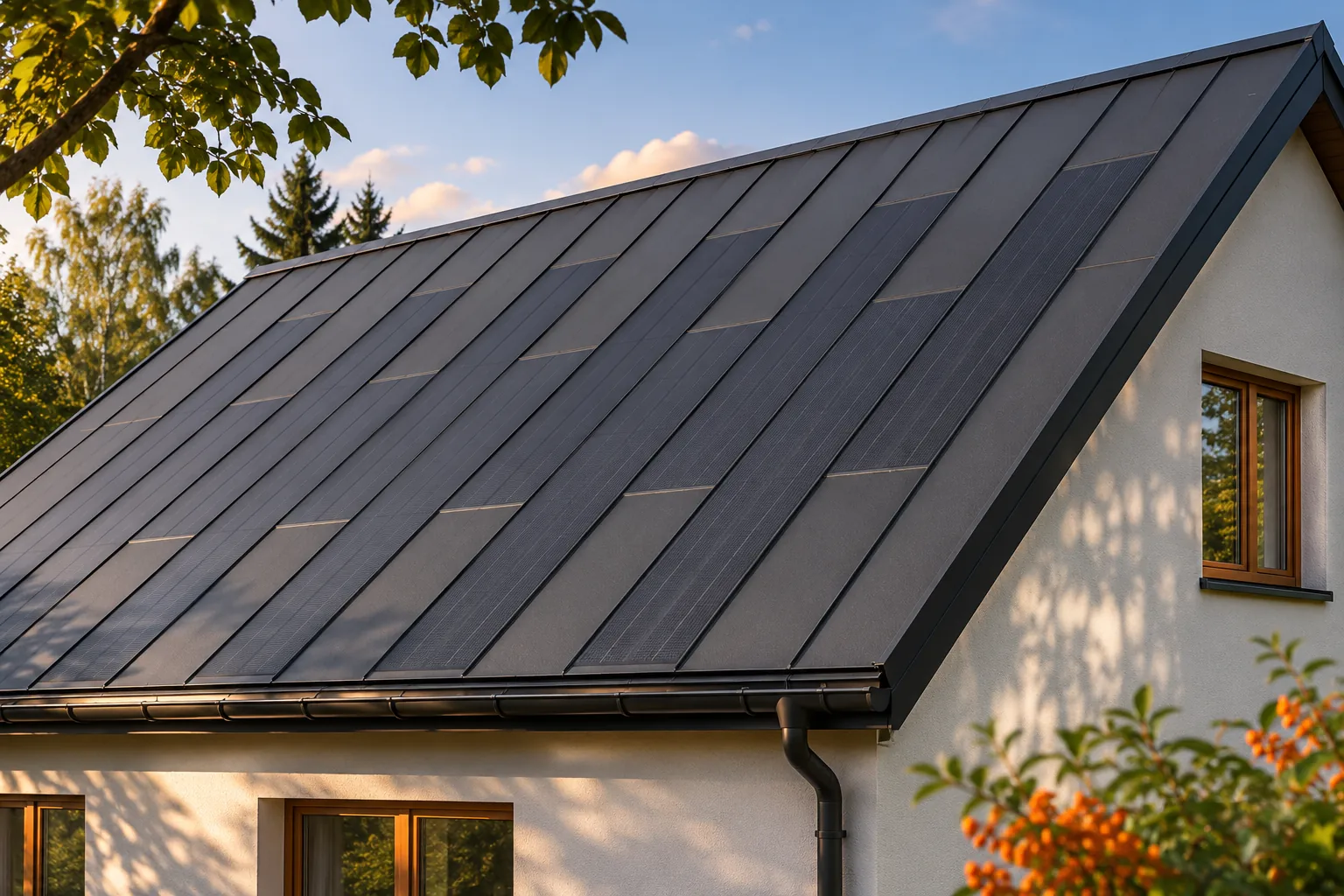
Shading on part of a roof does not have to rule out integrated photovoltaics. In a steel system, active fields can be planned in better-lit areas while the remaining surface is closed with passive covering. This keeps the roof visually consistent without installing cells everywhere. However, an analysis of shading over the course of the day and the year is needed. Only this will show whether the available areas justify the cost of the energy-generating part. The impact depends on the geometry of the obstruction, the duration of shading and the electrical layout. A narrow chimney shadow behaves differently from a neighbouring building that blocks a large part of the roof for many hours. The two cases should not be judged with a single label. Data relating to the specific house and the planned panel layout are needed.
Does shade on one section mean a problem for the whole roof slope?
It is worth starting by identifying the areas that remain best lit. These can form the core of the active section. If there are few such places, the design should show the realistic yield and cost. Sometimes a smaller system will make more sense, and sometimes a different installation location. A large roof area alone does not settle the choice.
It is also worth noting the duration of shading, not just its presence. A brief shadow and many hours of covering the slope lead to different design conclusions.
What does the passive part of the BIPV provide?
It allows a uniform composition to be created even where cells are not justified. In the steel variant, active and passive elements can maintain a common rhythm of divisions. The owner therefore does not have to choose between the maximum number of panels and an orderly appearance. This is an important advantage on a roof with uneven sunlight.
This does not mean optical differences disappear entirely. Surfaces may reflect light differently, so it is worth checking samples and real photographs. The design should show the boundaries of the zones and their proportions. A well-planned whole looks deliberate even when only part of the roof produces energy.
How should trees and neighbouring buildings be assessed?
Their height, position and changes over the course of the year must be taken into account. A deciduous tree may cast different shading in summer and winter. The decision should not be based solely on a single photograph taken in favourable sunlight. The analysis should show when and for how long the shadow covers the planned active fields.
It is also not worth building the entire plan on an uncertain promise to remove an obstacle. Felling a tree or changing a neighbouring structure may require separate decisions. The roof should be assessed according to conditions the investor can actually influence. Future changes can be included as a variant, clearly separated from the current state.
Does the electronics eliminate the effects of shading?
A suitable arrangement of devices can limit some losses resulting from uneven operating conditions. However, it does not create light where there is none. Therefore, promising a complete solution to the problem with optimisers or micro-inverters alone would be an oversimplification. The slope must first be well planned and the actual production estimated.
The choice of electronics should follow from a specific design and the compatibility of components. It is worth asking for a comparison of variants with clearly described assumptions. A difference in price only makes sense when set against the expected result. Not every roof requires the same configuration, even if both are described as integrated.
Can the active section be moved to another roof slope?
Sometimes a roof that is less obvious in terms of orientation has better conditions thanks to less shading. It is therefore worth comparing the available areas rather than automatically choosing one side. The timing of production relative to the home’s energy consumption also matters. The annual total is not the only useful piece of information.
In a consistent system, passive elements allow both roof slopes to retain a similar character. It is therefore possible to be guided by energy conditions without creating a random appearance. However, the electrical requirements and the way the fields are connected must be checked. Simply moving panels on a drawing does not complete the design.
When is a partially active roof a sensible choice?
When a new covering is needed and well-lit areas allow useful production at an acceptable cost. The quote should cover the entire slope, not only its active part. It should be compared with the full variant of a conventional roof and a separate installation. Then the aesthetic and organisational benefits of BIPV become clear.
A shaded roof requires a precise design, but not always a resignation from solar energy. The advantage of integration is the ability to calmly combine zones with different tasks. A good decision uses light where it is actually available and does not promise identical results from every part of the slope.
Players in the photovoltaic roof market include Autarq, MDM NT (MyRoof), Electrotile, GAF Energy, Ennogie, SolRoof, ML System, Megasol Energie, SunRoof and Wienerberger Wevolt.
7 branches. Materials closer to your project.

- SEROCK — Dzierżenin 34 E
- BŁONIE — ul. Sochaczewska 138A
- RADOM — ul. Grobickiego 8
- ŁÓDŹ — Natolin 8
- OLSZTYN — Barczewo, ul. Prosta 9
- WROCŁAW — ul. Jerzmanowska 10C
- GORZÓW WLKP. — ul. Zielona 33/34