Insulation and PIR
EPS, XPS or PIR: how to choose insulation by application
In brief
The three abbreviations denote different families of insulation. Each includes products with different purposes and parameters. The choice should follow from the installation location, moisture and load. Only then should thickness and price be compared. Good insulation under plaster need not be the right material under a loaded floor. EPS is expanded polystyrene. Its structure consists of bonded granules. XPS is produced by extrusion and has a different, closed-cell structure. PIR is rigid polyisocyanurate foam, often supplied with facings. They should not be treated as one material in different colours.
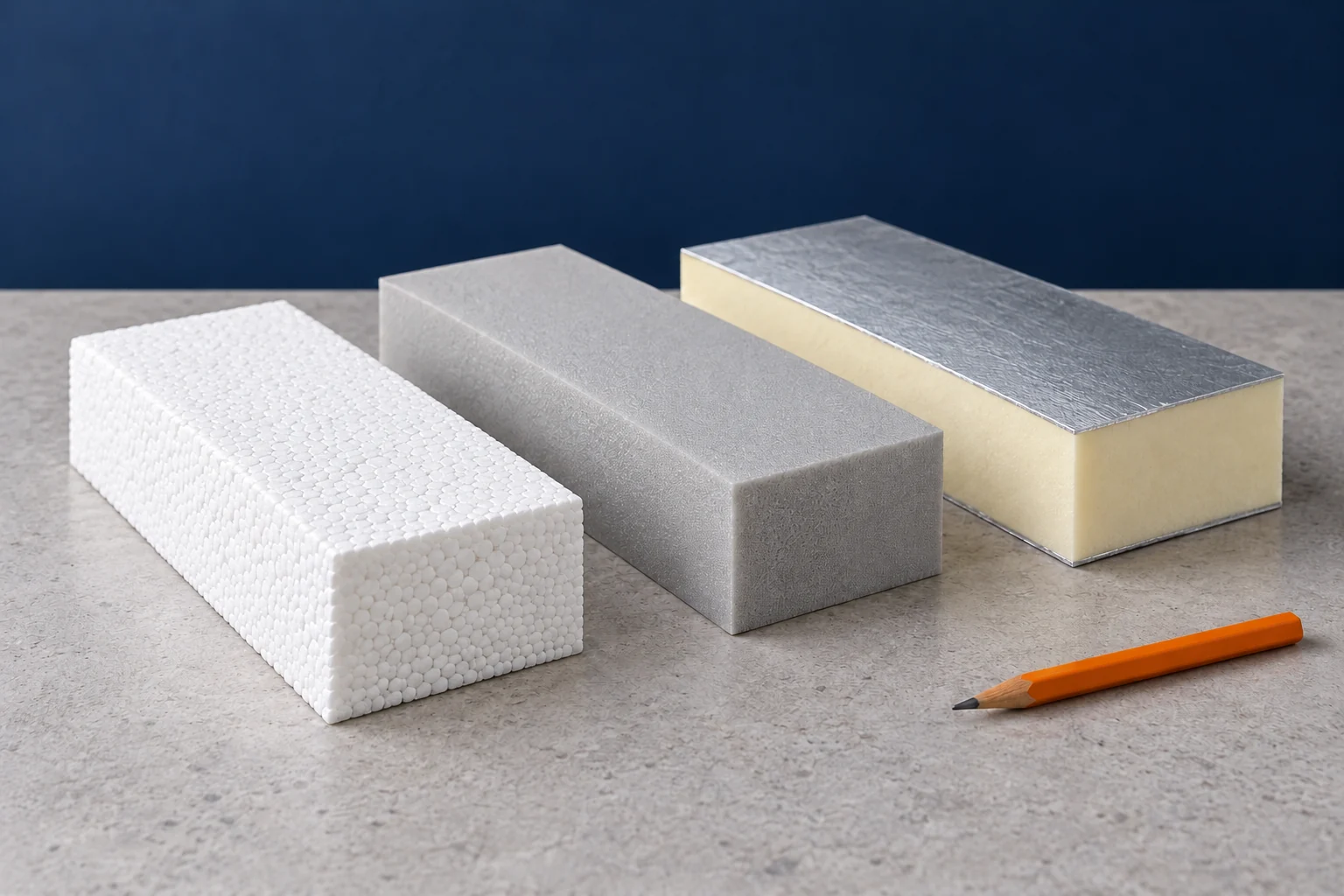
How do these three materials differ?
The specific variant matters. Within the same family there are products for different loads and conditions. The colour of the board is not sufficient information about its load-bearing capacity or lambda. The choice is determined by the description of use and the declared properties.
How to compare lambda and the required thickness?
An example EPS with a lambda of 0.038 W/(m·K), a selected XPS from the range 0.032–0.035 and a specific PIR with a lambda of 0.022 can be compared. These are examples of products, not fixed values for entire families. In PIR, the type of facing and the thickness may be associated with other parameters.
The resistance of a layer is calculated using R = d/λ. A lower lambda allows a smaller thickness to be used for the same resistance. However, it does not mean the materials are fully interchangeable. Fixing, finishing and moisture conditions must also be checked.
What to choose when the insulation is in contact with moisture?
In places exposed to water, water absorption and permitted use are important. Suitable XPS is used, among other things, in areas near the ground and in inverted roofs. There are also EPS variants with properties matched to specific damp conditions.
Do not transfer these applications to any facade board. PIR also requires the system and protection to be checked. A closed-cell structure alone does not replace waterproofing. Water should have a designed drainage path, and the material should perform under the conditions for which it is intended.
How to read parameters for floors and equipment?
In a floor, loads and deformation over time matter. Stress at 10% deformation is a test parameter. It is not a ready-made permissible value for permanent pressure. It should not be converted directly into the weight that can be placed on the finished floor.
Load distribution, floor layers and long-term conditions must be taken into account. A shelving leg acts differently from a uniformly distributed weight. Selection should also include the screed or a board that distributes pressure. Hardness perceptible to the touch alone is not used to assess the solution.
What is the significance of the board area?
PIR facing can be metallised, fleece-backed or adapted to another task. Each requires appropriate interaction with the finishing layers. Not every board can be plastered or bonded with the same product. Material compatibility is what counts in the system.
Similarly, the surface and edges of XPS should match the application. A rebate changes the way the boards meet and can affect coverage. When ordering, record these features, not just the thickness. Two similar packs may require different details and yield a different amount of usable surface area.

Where does the space constraint become decisive?
At a window, door threshold or low parapet, it is sometimes difficult to fit a thick layer. A material with a favourable lambda can help, but it must be suitable for the given assembly. It is worth drawing the full section and checking all layers, not just the insulation core.
Indoors, the finish and installation space are added. On a roof, the thickness is increased by the slope layer. At a plinth, moisture and impact resistance are important. Selecting one insulation for the entire building is not always justified. Different zones may require different products.
How can prices be compared without losing the required effect?
Compare variants with a similar thermal resistance and a suitable application. Add fixing, substrate preparation, sealing and finishing. Check the surface area per pack and the actual cutting yield. The price of one centimetre of thickness is not a measure of the cost of finished insulation.
Also take into account the fire requirements of the entire solution. Do not transfer the classification of one material to another. Changing the insulation may require the system to be reassessed. The final choice should combine technical compatibility, ease of installation and the cost of the scope that will actually be created.
On acceptance, keep the batch marking and the full product description. A later reorder of material in the same colour does not confirm the same parameters. The documents should be traceable to the boards actually delivered.
Questions before ordering
Is XPS simply a stronger EPS for every application?
No. It is a different family of materials, and the application depends on the variant. A higher compressive strength does not confirm compatibility with every façade or roof system.
Can insulation be selected on the basis of lambda alone?
No. Moisture, loads, fire, facing and the method of finishing must be taken into account. Lambda describes only heat conduction.
7 branches. Materials closer to your project.