Installation and details
Can you walk on an insulated panel roof during an inspection?
In brief
Do not assume an insulated panel roof is safe to walk on. Before an inspection, establish an access route and suitable protection. Ideally, plan both when choosing the roof covering, particularly if equipment on the roof will need servicing. A foot places a concentrated load on a small area. The top facing can deform locally even when the panel as a whole safely carries a distributed load. A snow load table alone therefore cannot establish that the roof is safe to walk on. The facings, core, supports and position of the load relative to the ribs and supports all matter. No single rule for foot placement applies to every profile.
What happens under a boot on thin sheet?
Damage does not always mean a leak straight away. A dent can, however, retain water or disrupt the interaction between the sheet and the core. A scratch from a stone lodged in a shoe sole worsens the surface protection. For this reason, both load-bearing capacity and the durability of the covering must be included in the assessment of access. Insulation thickness alone does not answer both questions.
How to establish a route to equipment?
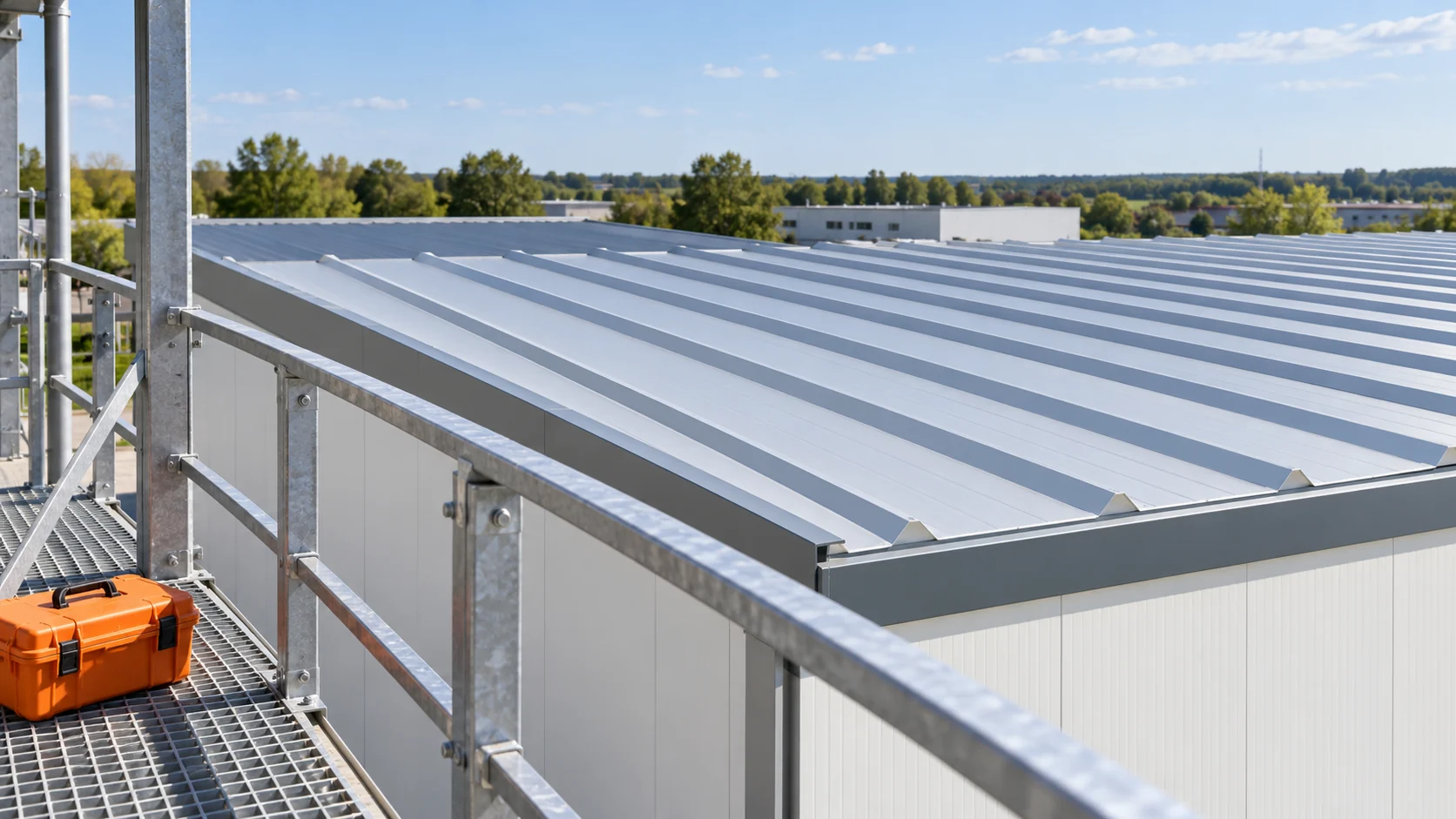
Mark the entry point, the route to the unit and the service technician’s working position. Also draw in the skylights, openings, roof edges and zones that must not be walked on. A short route is not always the right route. The route should take into account the structural design, the covering manufacturer’s instructions and the fall protection used.
If inspections are carried out regularly, provide designated walkways or access routes. Their fixing must transfer loads in accordance with the design. The thin cladding must not be treated as an arbitrary base for screwing on a support. When the position of a unit changes, also check the access route. A new air-conditioning unit may require a different access solution from the one originally adopted.
When does a load-distributing platform help?
A load-distributing solution can reduce local damage, but it must be intended for the given roof. Length, stiffness, support and securing against displacement are important. A loose board placed at random on the sheet metal does not provide confirmed safety. It can tip, slide or load the edge of a component.
The support of the walkway and the permissible load should follow from the established work plan. Also check the protection of the coating at the contact points. Metal particles or gravel under the pad act like abrasive. After the work is finished, temporary elements that could retain water or move in the wind must be removed. Permanent equipment requires appropriate fixing details.
What do weather and the condition of the covering change?
Wet, frosted or dirty sheet metal can be very slippery. Footwear alone does not eliminate the risk. Before entering, assess the weather conditions, wind, visibility and the possibility of a safe return. A roof may look dry after rainfall while remaining wet in a shaded area. Do not start work without assessing such differences.
Corrosion, loose fixings, delamination and old repairs require particular attention. Do not test the strength of a damaged section with your own body weight. A technical assessment and a decision on the method of access are needed first. Treat rooflights and similar infills according to their intended purpose. Visual similarity to the covering does not mean it can support a person.

How can damage during an inspection be limited?
Take only the equipment needed for the planned task onto the roof. Place it in designated locations without applying point loads to the cladding. Do not drag cables, heavy boxes or metal parts across the surface. During repair work, protect the area against metal filings. Remove them by a method that does not scratch the paint.
Do not stack pallets of material on the roof without checking the loads and the method of support. The weight given for a single element does not describe the weight of the entire pack. After work, inspect the access route, the standing positions and the vicinity of the equipment. Record any dents or scratches observed. Such a simple record helps distinguish earlier damage from problems arising during servicing.
What findings should be passed on to the team?
Provide the access plan, the circulation route, the load limits and the support points for equipment. Include information on the fall protection method and on procedures in the event of a sudden change in conditions. A message stating only that ‘the roof is made of 100 mm panels’ does not describe these issues. Likewise, a photograph of the building does not replace data on the structure.
It is worth keeping the support layout and inspection guidance in the building documentation. This facilitates subsequent repairs, drainage cleaning and servicing of installations. If service access was omitted at purchase, it can be designed later. However, the route should not be improvised on the first access. The cost of a well-chosen access route should be compared with many years of servicing the entire roof.
Questions before ordering
Does a thicker core always mean the panel can be walked on?
No. The entire element, the facings, the support and the local load are assessed. The number of millimetres of insulation alone is not an approval for foot traffic.
Can an inspection from a lift replace access on foot?
For some activities yes, if the reach and the organisation of work allow it. The method of access is selected according to the task and the conditions of the building.
7 branches. Materials closer to your project.