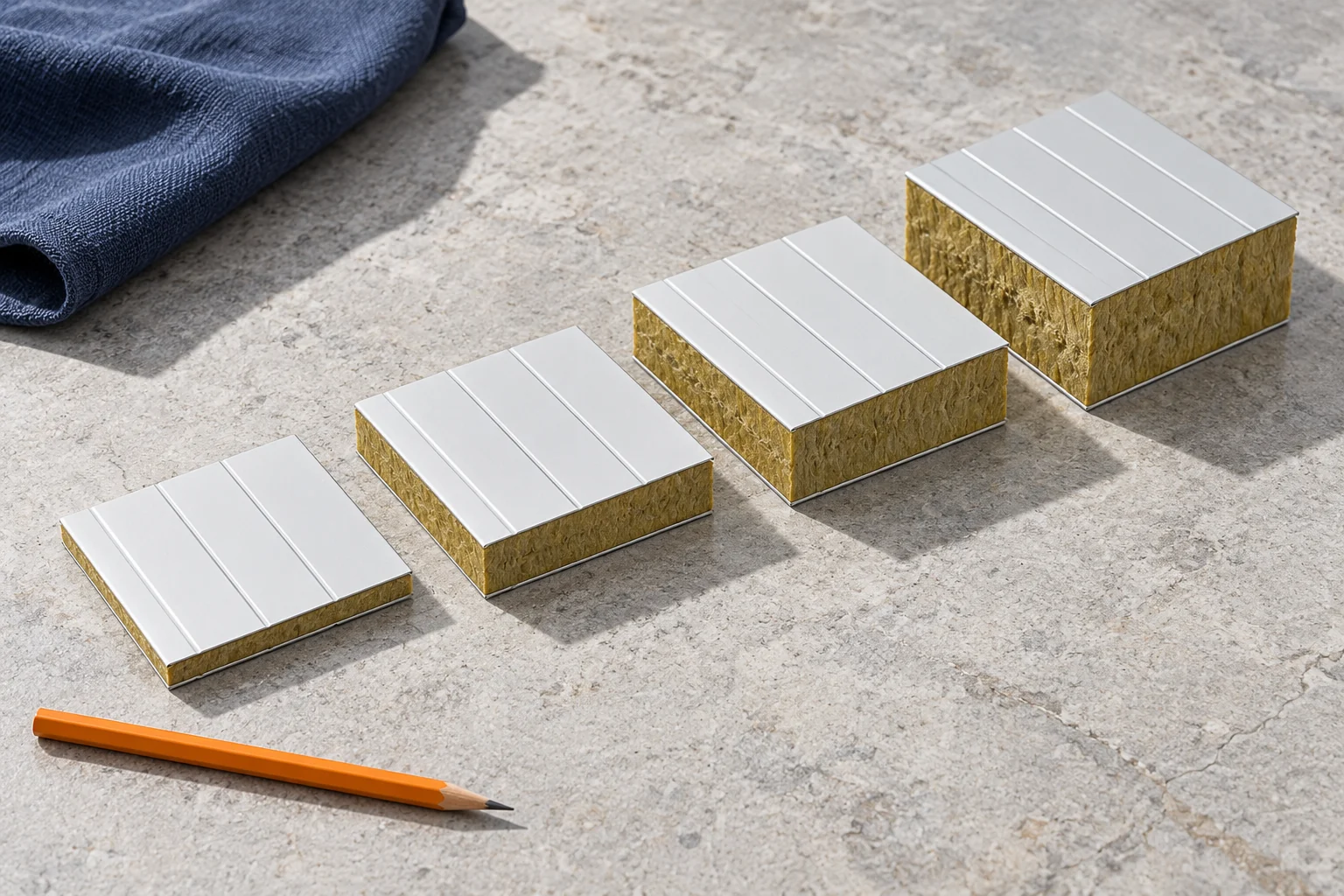
How do you go from the 60–200 mm range to the right mineral wool panel thickness?

The 60–200 mm range offers many options, but it is not a simple scale from the weakest to the best panel. Each thickness must match the wall's task. It is worth starting with the thermal, fire and load-bearing requirements. Then check the space for the cladding, the depth of the openings and the weight of the panels. Only this set leads to a specific choice. Describe the internal temperature, humidity and function of the room. Establish the fire protection and acoustic insulation requirements. Check the structural spacing and loads. The panel thickness will be the result of these data, not the starting point.
2026-11-14T09:32:42+01:00

Will a mineral wool panel soundproof the hall, and how do you read its acoustic parameters?

A mineral wool core does not mean that every panel absorbs noise well inside the room. A panel with full steel facings can limit sound transmission while reflecting it back into the room. First you need to establish the problem: noise outside, between rooms or reverberation in the hall. Each requires a different approach. Insulation describes limiting the passage of sound through a partition. Absorption concerns the energy that does not return to the room as a reflection. These are different properties. Material hidden behind full steel sheet does not behave the same as an exposed or suitably protected absorbent layer.

2026-11-14T09:33:38+01:00

Comparing PIR, EPS, XPS and mineral wool for roof insulation

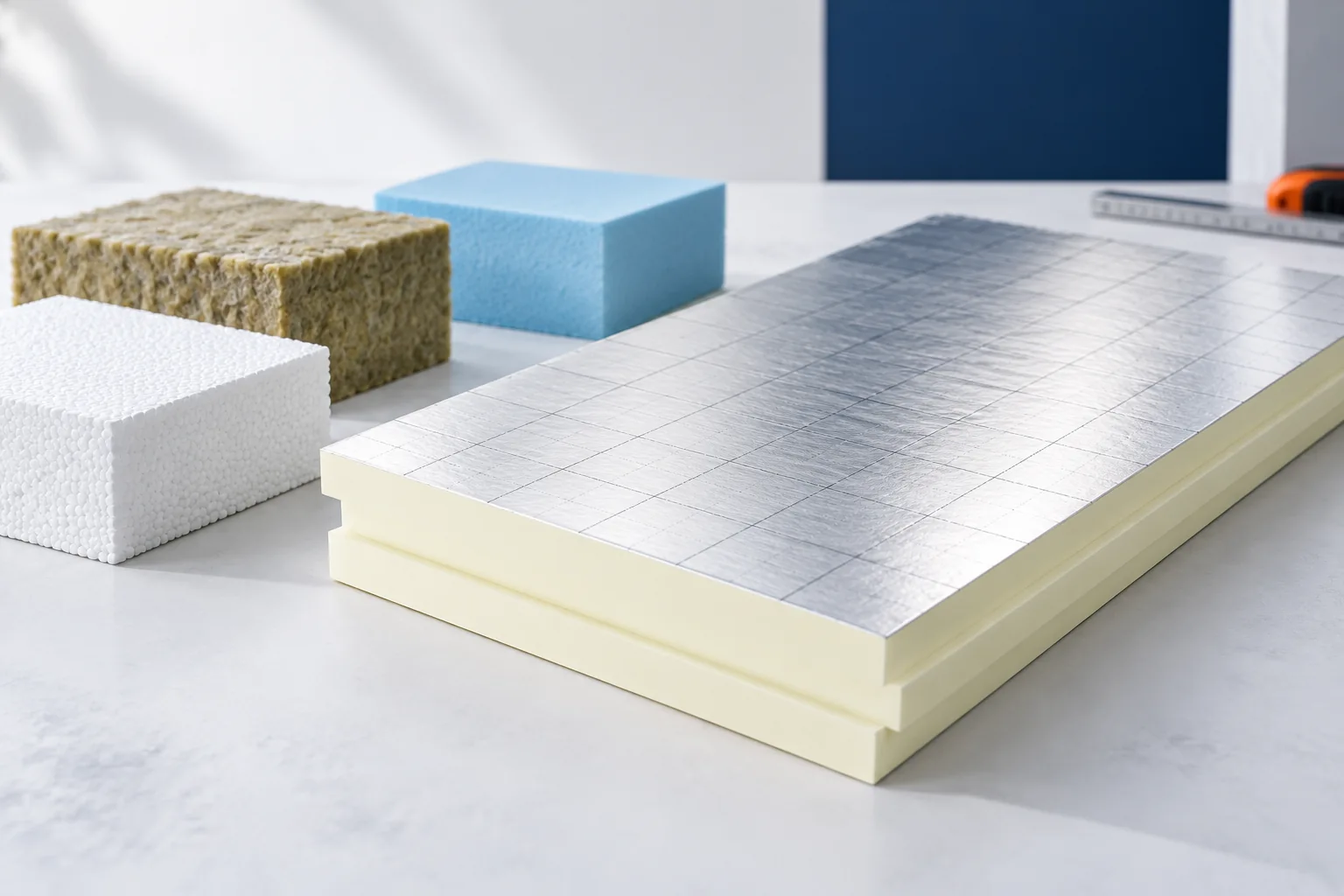
Begin comparing roof insulation with the required thermal resistance, not with board thickness. Check whether the chosen variant meets the project's fire, moisture and mechanical requirements. PIR with a lower lambda may need a thinner layer than EPS, XPS or mineral wool, which can matter where space is limited. For each product, establish the declared lambda and calculate R as thickness in metres divided by lambda. Only then compare the cost of the whole roof, including thermal bridges, fixings and flashings. Leave final thicknesses to the designer.

2026-11-15T02:34:51+01:00

How do you choose an insulated wall panel with a mineral wool core for a specific building layout?

The best wall panel is one that meets the building's requirements and can be installed correctly. Thickness alone does not determine the choice. Thermal, fire and load-bearing parameters must be checked. Dimensions are equally important. The panel module should work with the windows, door and support layout, rather than forcing random cuts. First define the function of the rooms, the temperature and the humidity conditions. Establish the fire protection and acoustic requirements. Only then compare specific panels. It is not worth choosing the thickest panel if the other properties still do not match the design.

2026-11-14T09:32:01+01:00

What determines the durability of a wall made of insulated panels with mineral wool?

The service life of a mineral wool panel cannot honestly be reduced to a single number of years. The wall works as a system of facings, core, locks and fixings. Water, surface damage and environmental conditions are of major importance. Durability should be planned at the plinth, corners and places that will later be difficult to reach. The steel facings protect the core and work with it to carry loads. The mineral wool provides insulation and participates in the performance of the whole element. The connection between the layers is essential. Therefore the condition of the external paint does not describe all the properties of the panel.

2026-11-14T09:31:59+01:00

Is a mineral wool panel non-combustible and what does A2-s1,d0 actually mean?

Mineral wool and a finished insulated wall panel are not the same product. The panel also contains facings, adhesives and joints. The classification of the whole product must therefore be checked. The A2-s1,d0 designation is also not a substitute for EI. The first concerns reaction to fire, the second the behaviour of the wall in a specific assembly. The core is one of the panel's components. In the finished element it works together with the steel facings and the other materials. The properties of the mineral wool alone cannot automatically be attributed to the whole product. The declaration relating to the specific panel must be read.

2026-11-14T09:32:55+01:00

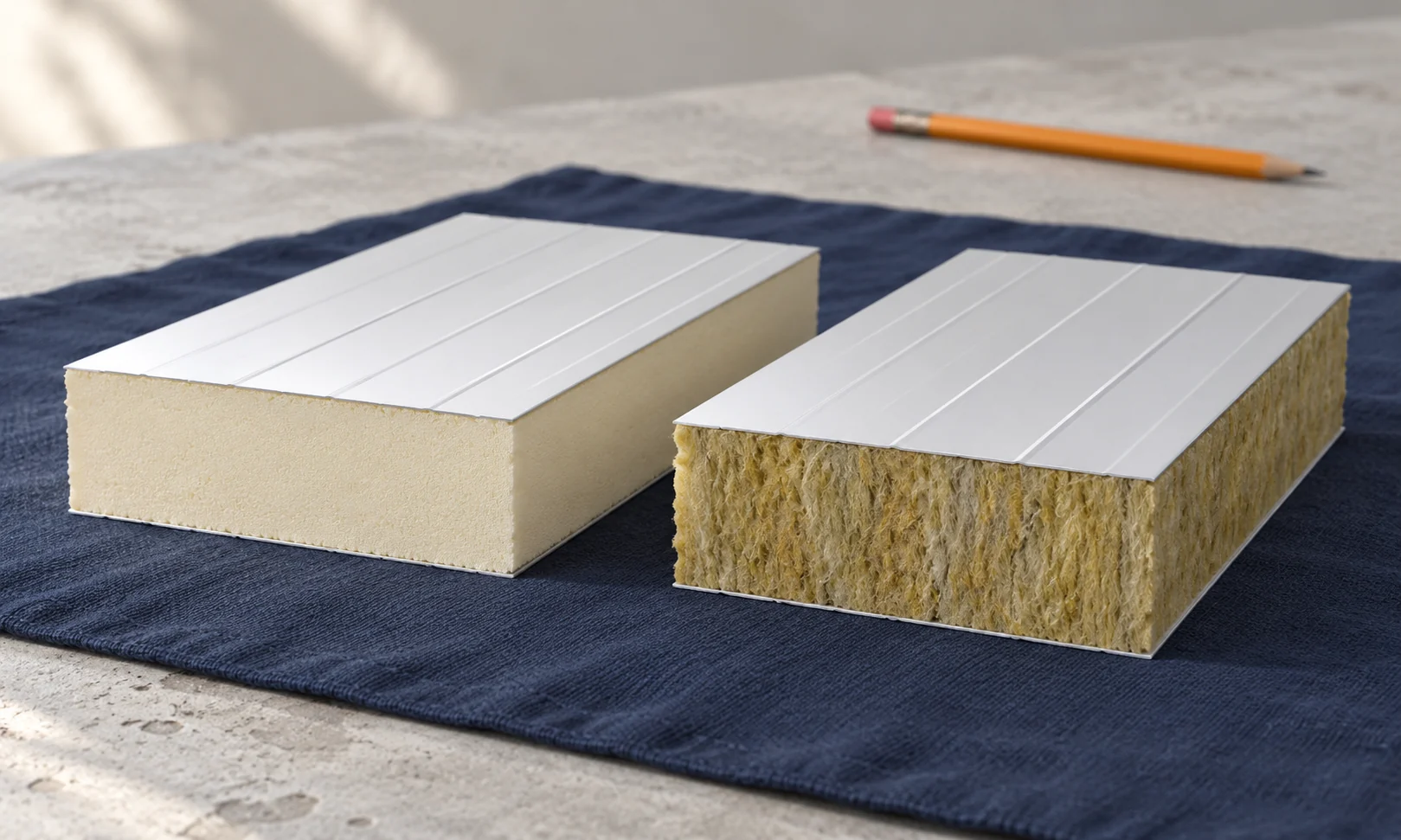
PIR or mineral wool: what to compare in a sandwich panel

PIR and mineral wool are not substitutes chosen on price alone. The choice starts with fire, thermal and structural requirements. At the same thickness, panels can differ in mass and U-value. It is worth comparing full configurations and checking how much space the finished enclosure will take up. First establish the project requirements, especially those related to fire. The reaction to fire of the material and the fire resistance of the partition are different issues. The classification of the complete panel covers a specific construction. Conclusions should not be drawn from the core name alone.

2026-11-14T11:58:35+01:00

How do you compare a lighter and a denser variant of an insulated wall panel with a mineral wool core?

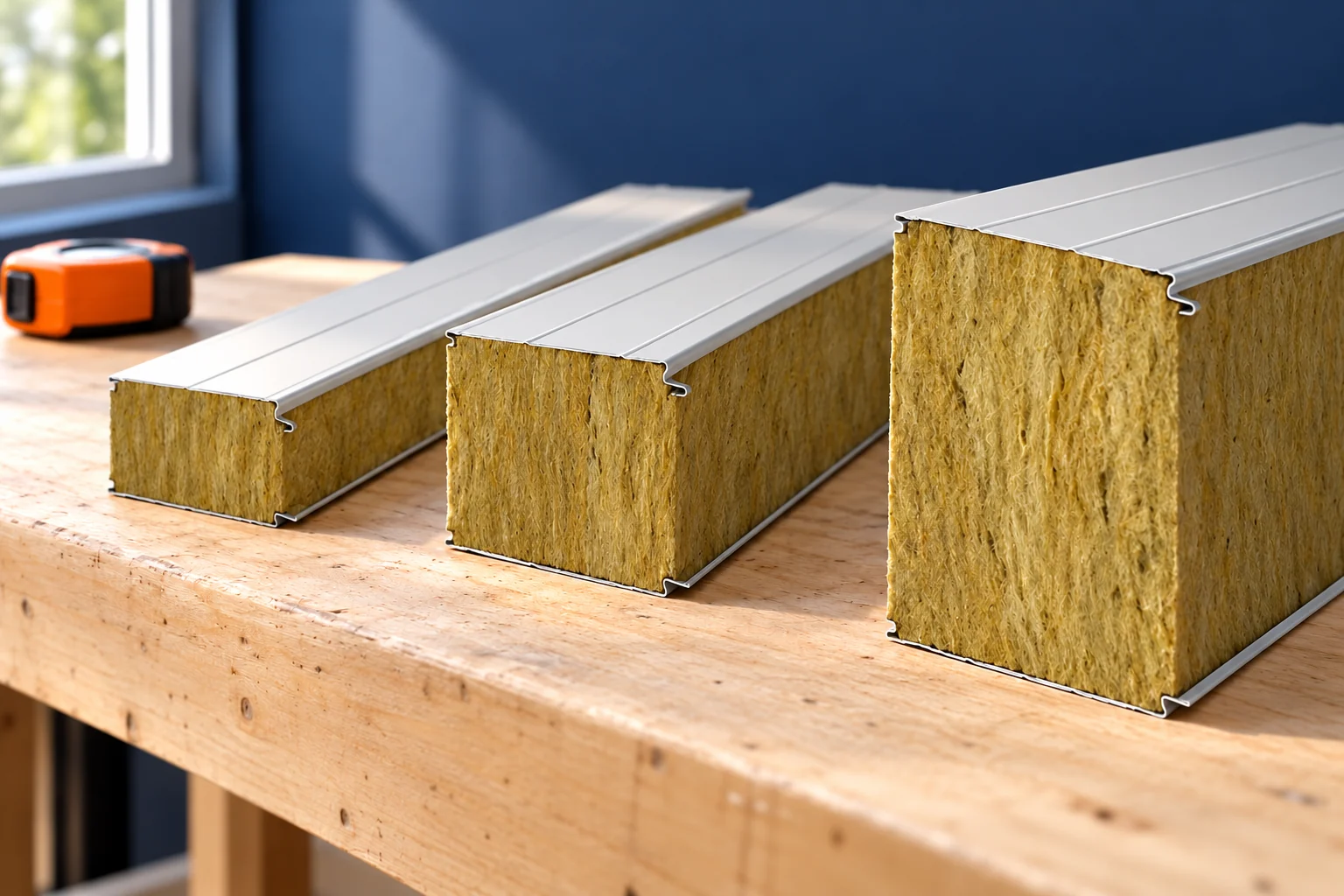
Two lines of mineral wool panels can look almost identical yet differ in core and parameters. The lighter variant is not by definition inferior. The denser one need not be the warmest. It is worth comparing specific values for one thickness and the same wall build-up. The name of the line does not replace such a comparison. The basic difference is often the density and structure of the mineral core. The facings, the geometry of the joint and the range of applications may also vary. One should not assume that the difference is limited to price or the amount of wool.

2026-11-14T09:32:57+01:00

How to read the U-value and lambda of an insulated wall panel with mineral wool?

Lambda describes the insulation material, while the U-value indicates heat transfer through the building component. These values cannot be compared directly. For a mineral wool panel, it is best to start with the declared U-value for a specific thickness. Then you need to check what the calculation covers and how the panel connects to the rest of the building. Lambda, written as λ, has the unit W/(m·K). The lower the value for a material, the greater the thermal resistance of a layer of the same thickness. In a simple case, the resistance R is calculated as the thickness in metres divided by lambda. Its unit is m²·K/W.

2026-11-14T09:32:18+01:00

How should the supporting structure for insulated wall panels with a mineral wool core be laid out?

The supporting structure for a mineral wool panel should follow from the panel layout and the loads. It is not enough to size the columns to the hall dimensions and then fit any cladding to them. Spans, support widths and openings must be coordinated. On a small building, a well-planned grid reduces the number of cut pieces and additional profiles. With vertical panels, supports often run horizontally. With horizontal panels, vertical support lines matter. This is a general relationship, and the exact layout follows from the design. The panel may act as a single-span or multi-span system, which affects the selection.

2026-11-14T09:32:22+01:00
Back to top