Costs and orders
How do seven purchasing decisions change the cost of sandwich panels?
In brief
The invoice for panels is influenced by much more than the rate per metre. Building dimensions, required parameters and the method of delivering the elements all matter. It is worth separating seven decisions that can be checked before ordering. This allows savings to be found without accidentally worsening the finished enclosure. A wall 10.2 m wide and 3 m high has 30.6 m². With a 1 m module, eleven strips are needed before cutting, i.e. 33 m². The difference is 2.4 m². This is a simplified example, without openings and corners, but it clearly shows the impact of final cutting.

1. Match the quantity to the layout, not just the wall area
Do not automatically add the same waste percentage to every building. Check which cut pieces have the right length, direction and edge. Sometimes changing the window axis improves the cutting layout. Such a correction must, however, remain consistent with the design and the user’s needs.
2. Choose the core and thickness according to the required function
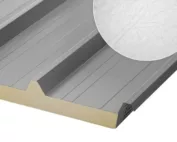
A thinner panel may be cheaper, but it will not provide any given level of insulation. Conversely, a very thick panel does not always deliver a benefit that justifies the cost. Compare the U-value, fire requirements, loads and interior conditions. The core is one element of this choice.
Do not equate a material’s lambda with the U-value of the complete panel. Nor should you compare the thickness of PIR and mineral wool alone as an equivalent thermal effect. If you anticipate a change of use, take it into account in the selection. Adding insulation later may require reworking the details at the openings.
3. Select facings and coatings for the environment
The interior of a dry warehouse places different demands than a room that is intensively washed. Colour does not say everything about the protection of the steel. The right coating and its resistance under the given conditions must be specified. Saving on this item may increase the cost of later maintenance.
Also check the thickness of both facings. It affects the properties of the specific panel and should not be changed without reassessment. When two offers have different facings, they are not the same product at a different price. Comparison requires setting out the full parameters.
4. Assess lengths together with transport and lifting
One long panel can reduce the number of joints, but it needs suitable transport and equipment. Shorter sections are often easier to carry in. However, they create new joints with support, sealing and flashings. The cost cannot be assessed on the number of pieces alone.
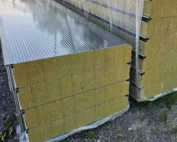
On a narrow plot, draw the route for moving the material. Take into account the fence, trees and existing building. Also measure the space for setting down the pack. Early identification of the constraint allows a realistic division to be chosen, instead of paying extra for emergency reloading on the delivery day.

5. Count the edge and fixing extras
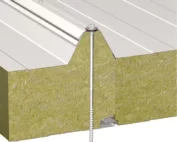
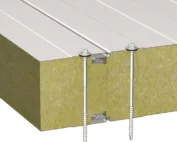
Flashings depend on the perimeter, openings and the number of bends. Two façades with the same area may need different numbers of metres of terminations. Screws, meanwhile, are selected according to the supports and loads. They are not an item that can be halved without checking.
For flashings, count the effective coverage after laps. Include corners and terminations. Also list the tapes and sealants appropriate to the details. The absence of an inexpensive component can halt the installation of a larger area. A complete schedule allows this part of the budget to be assessed before the team arrives.
It is worth checking the schedule of flashings against the unfolded elevations. This makes it possible to catch short sections at recesses that are easily missed on the building plan alone.
6. Put together the purchase with delivery and settlement terms
Illustrative example: 100 m² at €34.72 net and transport for €416.61 gives €3888.61 net. A second offer at €36.57 with carriage for €162.01 gives €3819.01 net. The higher panel price leads here to the lower total. These are accounting assumptions, not current rates.
Establish whether the price refers to an effective or a total metre. Check the logistical minimum, surcharges for a small batch and unloading. Compare amounts with the same tax and the same scope. A small difference in the unit description can matter more than a negotiated discount.
7. Prepare the installation so you do not pay for downtime
Before delivery, receive the structure geometry and finalise the arrangements at the openings. Organise access and equipment. If a support or space for a lift is missing, the team may not be able to use the planned day. This is a cost that is not visible in the price of the panels alone.
In the installation quote, separate laying, flashings, sealing and additional works. Establish who prepares the cut-offs and removes the packaging. A well-described scope makes comparison and acceptance easier. It is best to look for savings in fit and organisation before removing necessary enclosure elements.
Questions before ordering
Is a fixed waste percentage enough when ordering for any hall?
No. The quantity depends on the modules, openings and lengths. A cutting plan lets you check which offcuts can be reused.
Which amount should you compare after receiving several quotes?
The total for the matching material and the same scope of supply and accessories. The price per panel is only one part of the comparison.
7 branches. Materials closer to your project.